

The erosion of trust in government
In the aftermath of the economic crisis of 2008-2009, the world runs into even more serious economic trouble. Building on an erosion of trust in the Eurozone and in its ability to function properly, a second economic crisis hits Europe and the USA. This second crisis surpasses the first one in severity. People in Europe start to lose their trust in banks and in the stock market. This leads to calls for strong, decisive measures by the EU. The price of gold rises. Asia is not as badly affected as Europe, although it is affected by the loss of purchasing power in the USA and Europe.
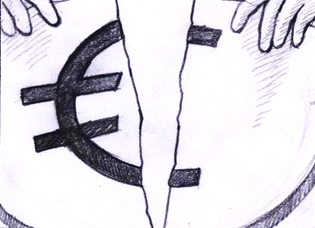
Economic Crisis in Europe
The economic crisis is not the only kind of crisis. Natural disasters seem to have become more frequent in the early 21st century. Partially fuelled by climate change and climate variability, they increasingly affect Europe and Asia. Throughout the decennium, floods, earthquakes, volcano eruptions, heat waves and droughts further accelerate the depletion of natural resources. Food production and food security are affected and prices rise sharply. This situation, in turn, fuels covert and open conflicts in Asia, the Middle East and Africa. In 2015, a nuclear accident in China leads to a massive loss of life which, in turn, leads to a noticeable drop in economic wellbeing throughout Europe and Asia.
People in Europe and Asia first call on their governments and on the EU to take decisive measures to counter the effects of the crises. The EU, however, finds it more and more difficult to reach agreement. With sharply rising costs, more EU member states run into serious financial trouble. The more affluent EU member states do not want to bail their neighbours out again and again. Calls for re-nationalising many policies become more urgent. Effectively, the EU becomes a two-tier system, with the economically weaker countries in the second tier forming a much more loose affiliation. The same happens in the ASEAN region, whose influence wanes across the continent. In the EU, citizens lose interest in the supranational construction of the EU and voter turnout for European Parliament elections drops to a mere 15%.
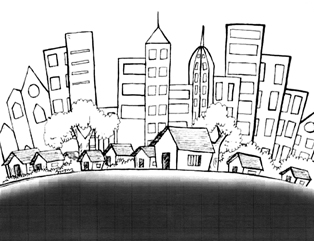
Growing Megacities
People in Asia and Europe look to their national governments for solutions. Many national governments attempt to follow their own separate ways in addressing problems. But where are the means? National budgets in Asia and Europe have been sharply reduced by the on-going financial crises and heavily burdened by natural and man-made disasters. Government administrations are overburdened. Citizens in Asia and Europe begin to realise that not just international institutions, but public authorities in general, are failing to solve their problems. Governments scramble for the respect and trust of their own citizens. The state has lost much of its financial muscle, governing power and legitimacy.
The series of disasters and the failure of governments to deal with them lead to a profound shift in priorities. Spurred on by the dire economic situation, economic growth and wealth creation become the overall priority. Individual action becomes key in recovering lost wealth. The market loses its strains. Social protection in the developed countries of Europe and Asia is reduced to minimum levels. State funds for development assistance to poor countries are cut sharply. Funding for international regional bodies and UN agencies is withdrawn or sharply cut. Collective action, solidarity and support to the poor increasingly depend on voluntary engagement and gifts.
A profit-driven world increasingly dominated by private companies and cultural groupings
The failure of governments and international institutions in Asia and Europe creates a void and public services, including health, are reduced across the board. Citizens turn to private companies, who seem to offer the security that governments are no longer able to provide. Specifically, large international companies understand the opportunities provided by these crises. Their engagement is welcomed and in many cases even demanded by citizens who call for jobs, products and services. In 2021, the bulk of existing health care systems within Europe has shifted towards private health care initiatives. Asia moves even further towards private health care. The commodification of health care services and goods – along with other public services – creates new market opportunities. Health companies stock vaccines and antivirals on behalf of multinational corporations and update the stockpile. This leads to greater disparities between the poor and rich populations.
Private companies and enterprises demand more rights and more exceptions from existing rules and regulations. Companies make use of the fact they are the ones that generate capital and employment. They become less and less bound by environmental, tax and labour legislation. This increases the risk of environmental exploitation, ecological abuse and inequalities, and also increases opportunities for innovation and economic development.
Governments and regional bodies in Asia and Europe continue to lose influence. Their initial attempts to take more national-protective measures are countered by the rising power of corporations who fight for easy market access. Many governments find themselves having to pay lip service to these companies. Governments are mere puppets in a game that they no longer control. This development is fuelled by the economic success of corporations. Many corporations in Asia are particularly active in providing services to large numbers of people (including the less affluent), fully exploiting economies of scale and the laws of large numbers. Mergers and alliances lead to globalised businesses and fierce competition, yet hardly any national ties. Corporations take over global governance.
Profit pushes R&D and innovation, which is now market-driven and not necessarily need-driven. SamSAP, resulting from a merger between Samsung and SAP, develops comprehensive e-health packages for individuals as an essential tool in global health systems. Moreover, starting in Japan e-doctors and medical robots increasingly replace health workers. Common diagnoses become a part of home-based health care.
Intellectual property is not effectively protected by states or international organisations, so copying is an easy way to create business. Companies are forced to release new products as quickly as possible on a large scale to make as much profit as possible before the idea is copied by others. Corporations therefore become more secretive and set up security divisions to protect their secrets from espionage. Because of the pressure to bring products onto the market, safety risks increase. Reacting to these problems, corporations agree to set up a global patent and copyright regime through a shared company.
Media and communication play an important role in societies. Personal and corporate communication is strongly interest-driven and supports a world of highly mobile people. Moving and travelling long distances and living in several places has become part of the normal life of many people – poor, rich and the many shades in between. It is a highly mobile world, in which differences between individuals are very important. Many cultural and lifestyle groupings develop in both the real world and in virtual environments. Within them, people feel at home and united; outside them, distance and protection are key. Bad news – real or imagined – travels quickly.
As a counter-development to the increasingly profit-driven and individualist society, many people turn to religious congregations or newly developed social groupings. These groupings increasingly replace the cohesive forces of nationality at turn of the millennium. They also provide protection and specific services and thus form a competition of sorts to corporations.
Strong disparities and a growing need for common approaches
Overall, the focus on markets and the stronger role of companies results in remarkable economic success. Asia and Europe regain lost wealth and flourish. At the same time, new challenges arise. Asia and Europe are faced with growing inner differences. More and bigger megacities emerge, and the disparity between urbanised and remote areas grows. Despite more effective food production due to industrialisation and distribution by corporations (up to 30% by 2030-2040), the problem of world food supply is not resolved entirely. The share of alternative sources of energy continues to increase, but the burden of the energy sector on the environment is still heavy.
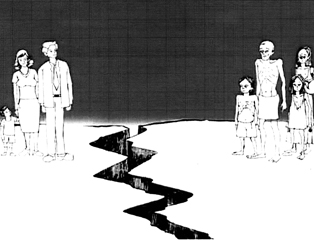
Widening Gap between Rich and Poor
These disparities add to the gap between rich and poor and the many shades in between. National boundaries have lost much of their importance. Many countries have split up - not even the larger countries of Asia could avoid this. Poorer areas in Asia and Europe are increasingly left to their own devices. Some start to develop alternative ways of living, often with old or new religious or social approaches. Many such areas, however, become a fertile breeding ground for crime and corruption. This also affects richer areas, which experience smuggling of goods and people, theft and robbery. This is an opportunity for organised crime to influence companies and what is left of governments. Illegal powers start to run certain areas. In some areas of Asia and Europe, conflict escalates and leads to violent clashes, sometimes involving the remnants of military forces.
Companies in Asia and Europe have already taken over many formerly public services, but growing problems add a new dimension to the challenge. Companies develop more extensive care and security systems for their clientele and employees. They increasingly take over a social role in society, teaming up with and supporting cultural groupings. The pressure to tackle imbalances on all fronts leads to broad calls for more coordinated, common approaches. Large companies, cultural groupings and the few remaining governmental structures create collaborative agreements as a new form of societal regulation to tackle problems. Implementation remains a problem. Towards the end of the 2030s, many wonder to what extent these can tackle the growing unrest in Asia and Europe.