

Forced and unpretentious moves to global responses
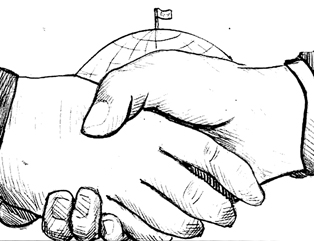
International Cooperation
In the second decade of the 21st century, Asia and Europe are starting to become used to global crises. The financial crisis that started in 2008 continues to have strong repercussions; in Europe, national governments face the need to save the Euro, under considerable pressure since the first waves of instability in 2010 and 2011. EU leaders are gradually being forced to go further with the Europeanisation of financial policies in order to avoid breakdown and to safeguard economic development.
Meanwhile, the economic and political influence of Asia continues to rise and, with it, the interest of Asian governments in creating a stable international financial architecture. The continued pressure from financial markets makes it obvious that European solutions alone will not be sufficient and that Asian governments need to take on more responsibility. Slowly and reluctantly, Asia and Europe lead the world to a new global financial system.
The on-going financial crisis is not the only problem. Environmental degradation is taking a high toll. Galloping industrialisation in Asia is placing a serious burden on the region’s health systems. Air quality in China, for instance, is now a major problem. Across Asia and Europe, extreme weather events fostered by climate change haunt societies: droughts, floods, massive snowfalls, heatwaves, etc. Increasingly, these problems lead to economic upheaval. Affected transport logistics are hitting the globalised economy at a sensitive point. Environmental migration increases pressures further. Security problems loom. Even if reluctantly and only pushed by crises, governments worldwide increasingly accept international coordination at the expense of national sovereignty.
It is the Asian states, however, which are decisively pushing for a more global approach to tackling crises. Economic turmoil has weakened the position of the USA and Europe. China, India and the ASEAN nations are not prepared to simply transfer power to UN bodies. Their doubts about the effectiveness of UN organisations come paired with a strong will to maintain their influence and room to manoeuvre. This provides an impetus to creating new international regimes with tight control over power under the umbrella of the G20 or occasionally in separately coordinated moves. Together with the existing UN bodies, this results in a complex setting of international bodies and governance structures.
No bold steps are taken at once. No great plans are developed. The move towards new forms of international governance is made carefully, step by step, unpretentiously and without much ado. The process shows results and enables newer forms of tighter cooperation that spill over into other policy areas. For the EU and its member states, the process seems familiar, reminiscent in some ways of the slow post-World War II integration process. Indeed, the EU’s experience with creating supranational structures with technocratic decision-making is a useful source of expertise, and also its long established lead in pushing environmental issues globally. Yet the longer-term consequences of this incremental process come as a surprise to the Europeans who continue to believe that they are in the driver’s seat; in reality, however, the car is a taxi that Asia is coming to steer independently.
Success through technocratic authority

Growing Industries
The technocratic approach is revealed in the world’s capacity to deal with some of its problems. Over time, financial markets stabilise. Environmental degradation in Asia is slowing down and in some cases is even reversed. The tighter grip on international coordination leads to solutions to some of the world’s longest-standing conflicts, such as in the Middle East. Sea routes become safer, with pirates facing concerted and merciless action. African countries stabilise and their markets open up. The result of international governance plays strongly into the hands of some Asian countries, with China in the lead and India following closely behind. Their economic credit is translated into decision-making power.
Asian world leadership provides different solutions to many of the world’s problems. Nuclear energy becomes the dominant source of energy. With rising Asian technology solutions for energy, the use of fossil fuels comes under tough international regulation. In order to cater for world food demand, international regimes agree on large-scale changes in agricultural production. As a result, in 2024 the world witnesses a record boom in industrial farming. The genetically modified (GM) crop industry is booming, with new, faster growing GM crops and animals. Farming communities become more sensitive to zoonosis. Europeans strongly protest the wide use of GM technologies, but Europe is no longer in a position to block agreements and their implementation. The continuing effects of climate change remind the world of the need for concerted action in a globalised world.
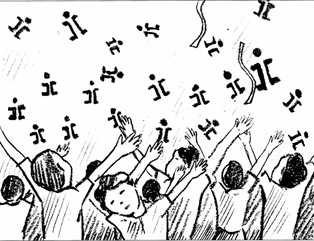
Celebrating Individual Freedom Day
Governments and governmentally controlled companies and agencies become strongly involved in R&D and assume the associated risks. Scientific research, R&D and innovation shift from the private to the public domain. Key developments include the end of the traditional patent system in favour of patent pooling, open-source innovation and global technology transfer to less developed regions. R&D is largely confined to universities, with production left to the private sector. Given the importance of health for the global system, the international regimes establish global and emergency health care systems. This goes hand in hand with basic education initiatives and new requirements for health education and training in behavioural change, leading to more equal and basic access to health care. There is a push towards preventive medicine. Meanwhile, private health care systems continue to exist. The improvements in health care and education lead initially to population growth and, eventually, to better control over major communicable diseases and decreased fertility rates in developing countries.
With these remarkable achievements, countries and governments outside Asia and Europe look increasingly to Asia for inspiration and reference. Western and European models provide "20th century recipes", states the 2027 declaration of the Organisation of African States, while "Asia provides the contemporary role models for development". Tightly controlled authoritarian political regimes with large degrees of economic freedom are symptomatic of an approach that is spearheaded by Asian countries and seen across the world as the most effective path towards broad progress in society. Also in the rest of Asia, this type of government is becoming the rule rather than the exception.
Challenges for a world under tight international control
Asia-dominated global governance is not without side effects. With large-scale development across Asia, cities become overcrowded. The green-city approaches and attempts to develop peripheral areas by the political leadership prove unable to change this dynamic. Much of Europe's top talent finds better conditions and more interesting challenges in the booming cities of Asia than in stagnating Europe. The relocation of the headquarters of a number of European multinationals to Asia (Nokia, Siemens, HSBC etc.) leads to large-scale protests in Europe. Tourism has become Europe’s major industry. Meanwhile, climate change thwarts world food production and the development and use of GM organisms is further accelerated.
With basic health services available to many and other basic needs catered for, average life expectancy now exceeds 90. The proportion of the elderly in societies has risen strongly. So has the number of elderly suffering from dementia. Having so many unproductive old people poses massive problems. Euthanasia becomes legalised and is applied widely. “Is obesity our new plague?” is a question asked by the main electronic news media in their headlines. Disenchantment with the tightly controlled way of life grows among people. Many flee from what they call 'grey paradise' into virtual worlds where free space is abundant. Among youth, there are striking cases of social-media-coordinated group suicides, or 'flash-mob self-euthanasia' as it is called in the public electronic wills of those engaging in the practice.
Meanwhile, the global governance system suffers from increasingly byzantine bureaucratic structures. More and more frequently, mistakes are made and covered up. Discontentment rises. Business people complain behind closed doors about the inefficiency of the governmental systems. Other parts of societies wonder more and more openly if the way chosen really is the right one. By 2035, 'Individual Freedom Day', launched as a virtual event by computer hackers in the Philippines in the mid-2020s, has developed a massive following across Asia, Europe and the rest of the world. Groups of minorities call for autonomy and independence. Autarchic groupings try to disconnect from cities in their attempt to flee the grip of authorities. New religious groups that mushroomed throughout the 2020s and 2030s start heated debates over the need or not to stop experiments with human cloning and genetic manipulation. As 2040 approaches, Grey Paradise is in a shaky situation.