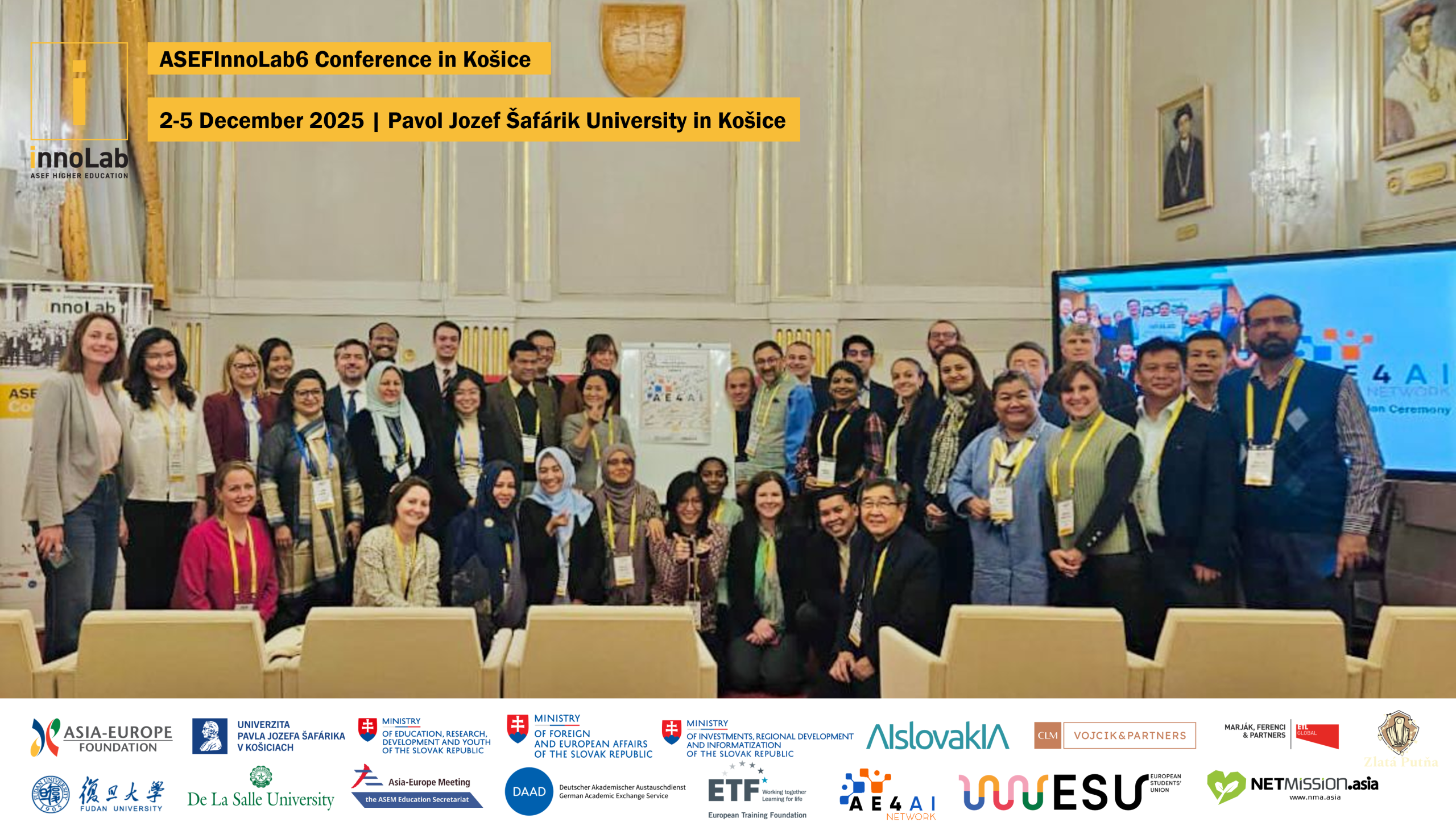
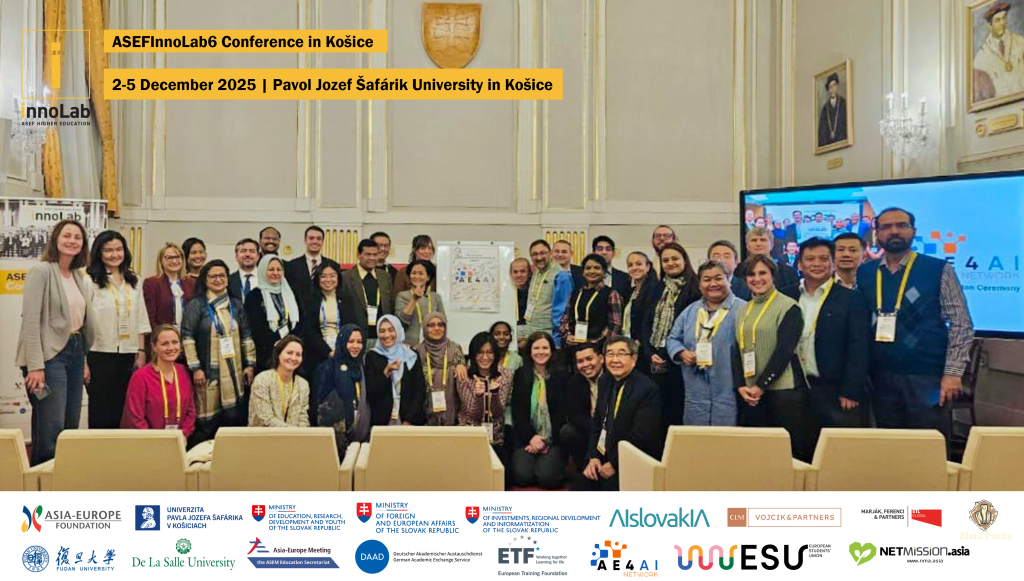
The 6th ASEF Higher Education Innovation Laboratory (ASEFInnoLab6) Conference in Košice, Slovakia was conducted on 2-5 December 2025 at our implementing partner institution, the Pavol Jozef Šafárik University in Košice (UPJŠ).
The event gathered 32 academics and higher education experts coming from 18 countries to discuss the role of universities in developing skills for the age of AI, and develop related academic papers that ASEFInnoLab6 participant teams have been preparing since summer.
Opening Day: AI Skills for the Future
The first conference day began with welcome messages from our partner representatives:
- Ambassador Roman BUŽEK, ASEF Governor for Slovakia
- Prof Daniel PELLA, Rector, Pavol Jozef Šafárik University in Košice
- Mr Denis NEDELKA, Director of Internationalisation of Higher Education Department, Ministry of Education, Development, Research and Youth of Slovakia
- [Online] Mr Radoslav ŠTEFÁNEK, State Secretary II., Ministry of Investments, Regional Development and Informatization of Slovakia
The speakers highlighted the importance of dialogue and collaboration in the intersection of innovation and higher education. They also emphasized Slovakia’s commitment to contributing to the international AI innovation ecosystem, which was reflected in the strong institutional support for the conference.
This was followed by two outstanding keynote talks:
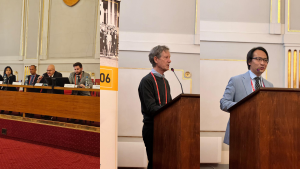
- Prof John Shawe-Taylor (University College London, UNESCO IRCAI), whose presentation emphasised how universities are shaping anAI-driven world from pioneering machine learning research to building ethical, inclusive, and sustainability-focused AI ecosystems.
- Dr Tuan Trinh (28DIGITAL), who discussed how cross-cultural excellence and innovation can strengthen digital education in an AI-driven world. His talk covered industry-academia bridge-building through transformative summer school models that prepare learners for future skills.
Accelerating Collaboration in AI-related Research, Policies and Frameworks
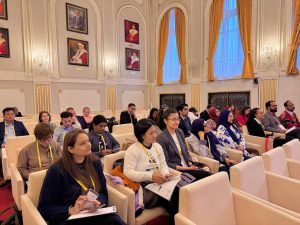
A key part of the week-long conference were academic paper presentations, which introduced the research of our 8 participant teams to the rest of the cohort. Each team presented the main findings of their paper and received peer feedback to incorporate for the end-of-year submission. The event featured insights from the following teams:
- Dr Nadeem MAHMOOD (University of Karachi) and Dr Tehreem
MASOOD (Superior University) presented their reseach “Bridging the AI Skills Gap in Higher Education: A Scenario-Based Framework for Rapid Micro-Credential Development in Asia and Europe,” which explores the “institutional agility gap” and proposes a framework through which micro-credentials can be developed. - Dr Vanessa Camilleri (University of Malta) and Dr Tiong Hoo LIM (Universiti Teknologi Brunei) introduced the paper “Institutions at the Edge of AI: Policy and Ethics for Cross-Regional Innovation in Higher Education,” examining institutional interpretation of fairness, its operationalisation, and gaps and points of convergence.
- Dr Zsolt Almasi (Pázmány Péter Catholic University), Mrs Jolanta Pietrkiewicz-Knecht (PELION S.A.), and Mr Henry Encabo (University of Southeastern Philippines) presented their research on “Artificial Intelligence Development and Governance: Ethical and Regulatory Lacunae, Cross-Cultural Challenges, and Practical Solutions”. Their work aimed to examine university AI policy documents and identify lacunae to improve institutional guidelines.
- Dr Manmeet Kaur (O.P. Jindal Global University), Dr Quoc Cuong Nguyen (Dong Nai Institute of Innovation), Ms Leila Benabdallah (OCEANS Network), and Ms Thi Kim Anh Vo (Ton Duc Thang University) shared their developing paper “Building an Inclusive AI Ecosystem: Insights from Selected Higher Educations in Europe and Asia”. This paper investigates how AI adoption transforms universities into innovation ecosystems, focusing on equitable and sustainable adoption.
- Dr Peipei Yu (University for the Creative Arts) and Dr Muhammad Zahid Iqbal (Teesside University) shared insights on “Reframing Creativity: AI’s Emerging Influence on Art and Design Pedagogy from Studio to Screen”, which describes the ways in which AI is reshaping creative education and explores options of responsible AI adoption to enhance creativity rather than diminish it.
- Prof Sabrina Scharpen (Berlin University for Technology), Prof Judel Roman (National Teachers College), Prof Sravani BHARANDEV (BITS Pilani Hyderabad), and Dr Mildred Libot (Commission on Higher Education) delivered a presentation on “Breaking Barriers: Generative AI Access in Higher Education towards a Minimum Access Standard for Educators in Europe and Asia”. Their research aims to understand the barriers for accessing AI tools and related structural inequalities, and assess possible supportive measures.
- Dr Saltanat Akhmadi (Nazarbayev University), Dr Madhuri Isave (Tilak College of Education), and Dr Aneela YASMIN (RMIT University) presented on “The AI Creativity Paradox: Is AI becoming a shortcut or an amplifier for the thinking process?”. They shared ways in which AI alters creative cognitive architecuture, implications for educators, designers and institutions, and associated policy recommendations.
- Prof Ram B Ramachandran (OP Jindal Global University), Dr Dalma Lilla Dominek (Ludovika University of Public Service), Anshumaan Goel (OP Jindal Global University), Dr Fernaz Narin Nur (Military Institute of Science and Technology), and Dr Ika Noer Syamsiana (State Polytechnic of Malang) covered their developing paper “Effortless Effort? Investigating the Cognitive Impact of GenAI Assistance on Student Learning Across Asia and Europe”. They introduced the AI cognitive paradox, implications for high-order thinking skills, and recommended policies for clear frameworks of appropriate AI use.
Incisive Keynote Talks from a Diverse Set of AI & Education Leaders
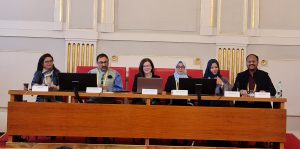
Following up on the keynotes from the opening day, an impressive lineup of speakers added another dimension to the conference knowledge sharing by presenting insights such as:
- Mr Matej Štefánik (Ministry of Investments, Regional Development and Informatization of
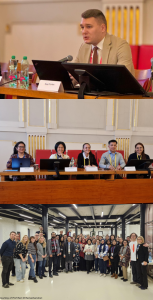 the Slovak Republic) held a presentation whichhighlighted how countries like Slovakia can carve out a confident role in an AI-driven world by building strong regulatory frameworks, strategic partnerships, and future-ready skills.
 - Mr Ronald Blaško (Research and Innovation Authority of Slovakia) explored how AI’s rapid evolution demands a new kind of human edge—one rooted in curiosity, creativity, ethical judgment, and collaborative intelligence.
- Prof Shen Yi (Fudan University) highlighted how AI education is key to strengthening global AI governance, helping close gaps caused by rapid technological change, fragmented policies, and unequal capabilities across nations.
- Dr Soňa Ftáčniková (Slovak Center for Scientific and Technical Information) underscored that ethical publishing, research integrity, and responsible AI use are now critical safeguards needed to protect scientific credibility and preserve public trust in the age of GenAI-accelerated output.
- Dr Vicente Pitogo (Caraga State University) talked about the incredible potential of countries part of the Global South in the age of AI. He outlined what AI-ready universities look like: rooted in ethical governance, skilled people, context-responsive innovation, and scalable solutions.
Utilising Unique Perspectives from ASEM Education Experts
On the third day of the conference, the main ASEFInnoLab6 cohort was joined by the ASEM Education Expert Group on Digitalisation and AI (EG). The EG first held its hybrid meeting in the UPJŠ premises, and then its 7 onsite members contributed to the conference by sharing insights, feedback and suggestions to the paper-developing teams.
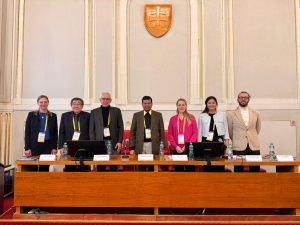
Moreover, the EG presented a thoughtful roundtable discussion titled “Higher Education for an AI-enabled Future: Balancing Innovation, Equity, and Autonomy amid New Opportunities and Challenges” moderated by Ms Stefanie Engert (German Academic Exchange Service). Ms Vera Lucke (ASEM Education Secretariat) introduced the cohort to the ASEM Education Process, followed by tone-setting presentations from Dr Alessandro Brolpito (European Training Foundation) and Ms Christelle Agustin (SEAMEO RIHED)—each carrying a rich regional perspective, with further inputs shared by Prof Bundit THIPAKORN (King Mongkut’s University of Technology Thonburi), Prof Karanam PUSHPANADHAM (The Maharaja Sayajirao University of Baroda) and Mr Marco COMOTTI (Erasmus Student Network).
We want to express our gratitude to the EG for enriching the conference, with special thanks to the German Academic Exchange Service and ASEM Education Secretariat for the organisational support.
Connecting the Dots for the Košice Manifesto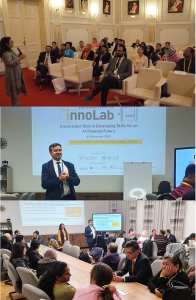
Since the beginning of the ASEFInnoLab6 in May 2025, participants in the academic papers track were guided by two outstanding facilitators—Dr Claudio RIVERA (RTU Riga Business School) and Dr Lafifa JAMAL (University of Dhaka, Bangladesh). This duo supported the teams throughout their journey towards the academic papers, addressing content issues, research methodology and team dynamics.
At the Košice conference, they were instrumental not only in providing presentation feedback and facilitating the event, but also navigating towards one of the main ASEFInnoLab6 outputs: the Košice Manifesto. This collaborative document outlines the principles “On Making Higher Education Institutions (HEIs) Enablers of Smart AI Dissemination for an Inclusive, Ethical, and Future-Ready Society”, and will be made public in early 2026.
Closing Ceremony and Final Reflections
To conclude the successful event, ASEF’s Deputy Executive Director Mr ZHANG Lei shared his closing remarks stating appreciation for all participants and the exceptional hospitality in Košice. The main local organisers, Prof Gabriel SEMANIŠIN and Dr Renata BAČÁROVÁ (both Pavol Jozef Šafárik University in Košice) followed up by reflecting on the conference and wishing for more joint projects in the future. For this purpose, ASEF then initiated the cohort as new members of the Asia-Europe for Artificial Intelligence (AE4AI) Network, which serves as the ASEFInnoLab collaboration hub.
Our sincere thanks goes to all participants, partners, organisers and supporters of this wonderful conference, and we look forward to transforming the cohort’s academic papers into a publication in 2026!