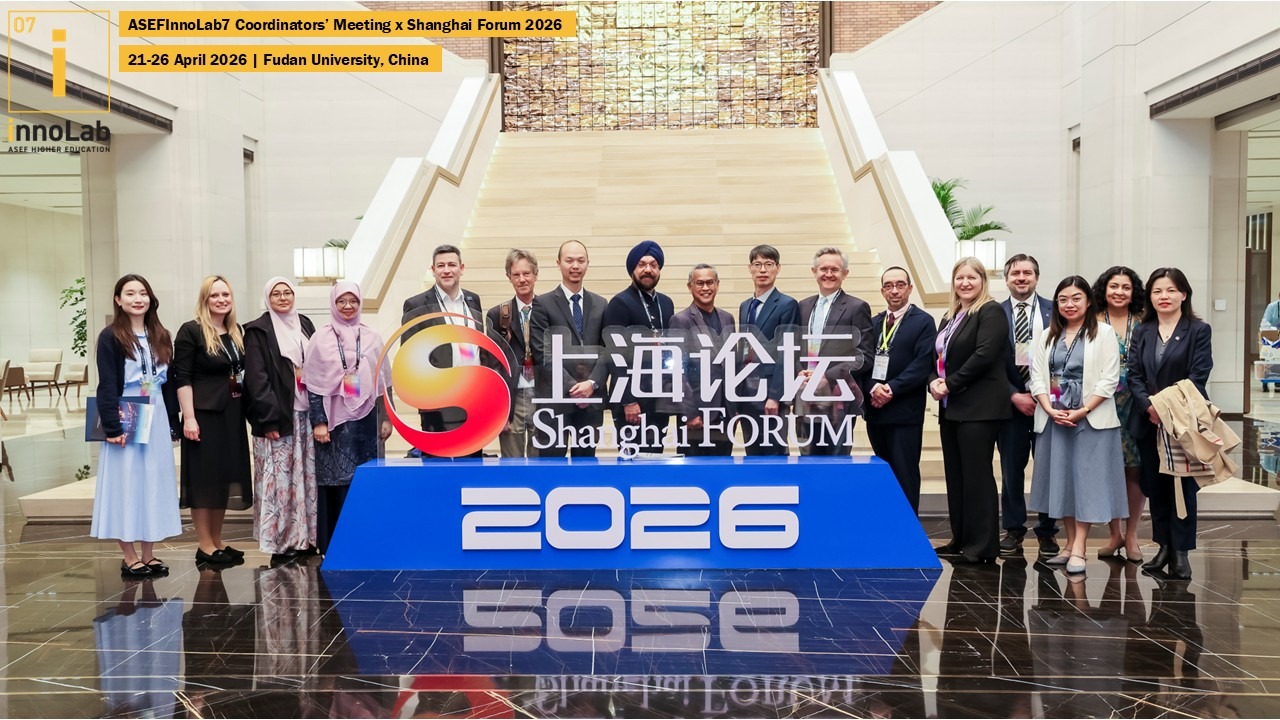
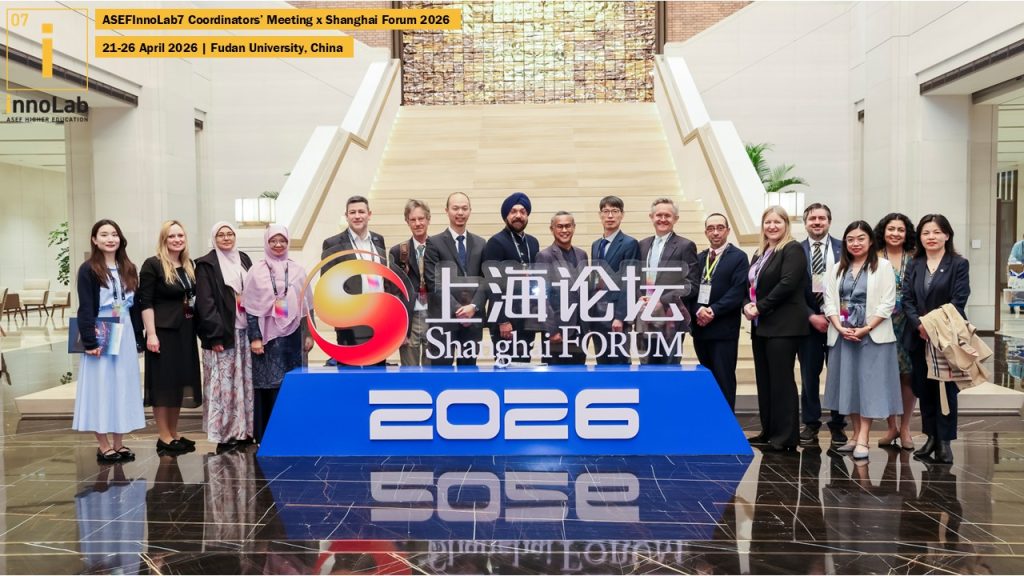
We are proud to share that the Asia-Europe Foundation (ASEF), in partnership with Fudan University, successfully convened the ASEFInnoLab7 Coordinators’ Meeting from 21 to 26 April 2026 in Shanghai, China. Hosted at Fudan University and organised at the sidelines of the prestigious Shanghai Forum 2026, the meeting brought together the expert coordinators of the ASEFInnoLab7 White Paper Lab to lay the groundwork for the programme’s collaborative white paper development process.
The 7th ASEF Higher Education Innovation Laboratory, themed “The Role of Universities in Advancing AI for Good”, explores how universities can help ensure that artificial intelligence (AI) is researched, governed, and applied in ways that support the common good. Through the White Paper Lab component, ASEFInnoLab7 will convene experts, academics, and higher education professionals from Asia and Europe to co-develop strategic white papers offering insights and recommendations for higher education leaders and policymakers.
The week in Shanghai served as both a strategic planning space for the White Paper Lab and an opportunity to bring ASEFInnoLab7’s core questions into a wider global dialogue on innovation, governance, and AI for good.
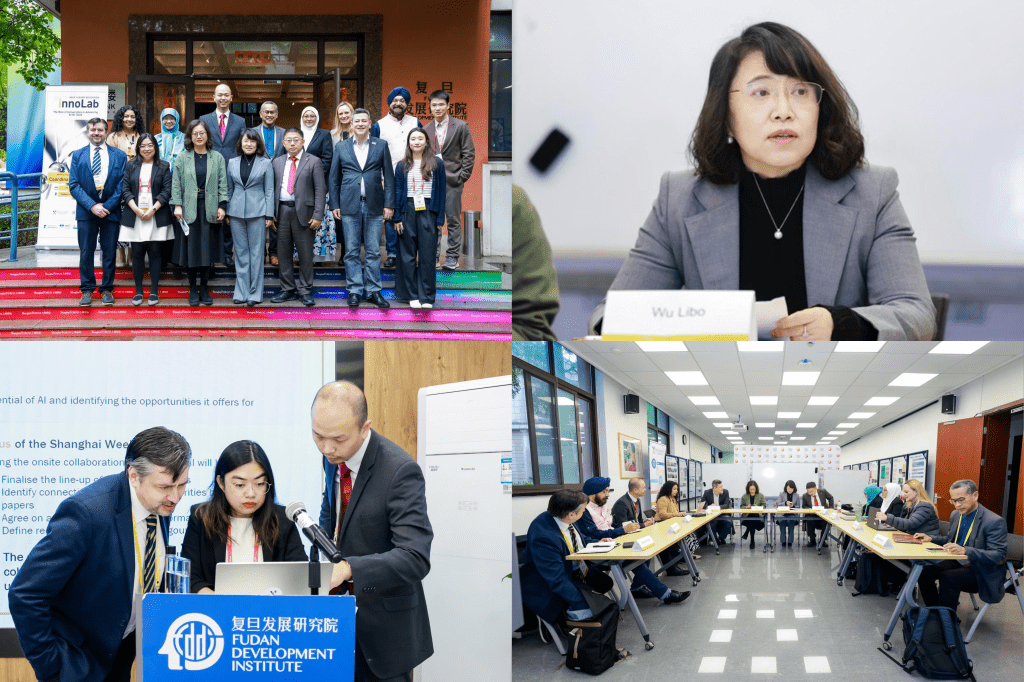
The Coordinators’ Meeting opened with welcome remarks from senior representatives of Fudan University, underscoring the continued partnership between ASEF and Fudan University in advancing higher education dialogue between Asia and Europe.
- Prof Wu Libo, Assistant to the President of Fudan University, welcomed the coordinators and highlighted the responsibility of universities to help ensure that AI advances human well-being and contributes to a more ethical, inclusive, and socially beneficial future. She also shared Fudan University’s advances through its AI for Science initiatives, pointing to the growing role of universities in linking technological innovation with wider societal needs.
- Prof Shen Yi, Director of the International Research Institute for Global Cyberspace Governance at Fudan University, traced the journey of ASEFInnoLab and the university’s history of collaboration with ASEF. He emphasised the importance of cross-border cooperation, noting that the challenges surrounding AI governance require shared approaches, stronger dialogue, and continued collaboration.
- Prof Zhang Yi, Executive Dean of the Fudan Development Institute, also joined the opening session to welcome the expert cohort.
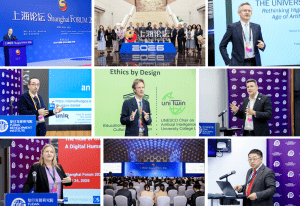
A major highlight of the week was ASEF’s contribution to the Shanghai Forum 2026, a high-level international dialogue platform hosted annually by Fudan University and the Chey Institute for Advanced Studies. Under the Forum’s theme “The Age of Reconfiguration: Innovation and Global Governance,” it gathered leading voices from across government, academia, technology, climate science, and global governance.
ASEF supported Fudan University’s International Research Institute for Global Cyberspace Governance in co-organising Sub-Forum 5 on “The Role of Universities in Promoting AI for Good,” chaired by Prof Shen Yi.
The sub-forum featured contributions from Prof Shen himself, alongside high-level experts nominated by the ASEFInnoLab network:
- Prof Simon Chesterman, David Marshall Professor and Vice Provost (Education Innovation), National University of Singapore
- Prof Daniel Burgos, Vice Rector for International Research and UNESCO Chair for eLearning, Universidad Internacional de La Rioja, Spain
- Prof John Shawe-Taylor, Director of the Centre for Computational Statistics and Machine Learning and UNESCO Chair on Artificial Intelligence, University College London, UK
- Prof Julia Neidhardt, Assistant Professor and UNESCO Co-Chair on Digital Humanism, TU Wien, Austria
- Prof Lampros Stergioulas, Professor & UNESCO Chair on AI and Data Science for Society, The Hague University of Applied Sciences, the Netherlands
Speakers reflected on the need for universities to continue educating the whole person in the age of AI. This should not only be limited to transferring knowledge, but also include strengthening judgement, critical thinking, ethical reasoning, and the capacity to understand both the possibilities and limitations of AI.
They also highlighted the important counterbalancing role of universities as industry increasingly drives AI development at scale. In this context, universities can advance independent research, shape ethical and public-interest agendas, and support responsible applications of AI across society.
The discussions further emphasised that “AI for Good” must go beyond risk mitigation. It should be understood as an active societal project grounded in human-centred values, interdisciplinary collaboration, responsible data practices, and a clear commitment to public value.
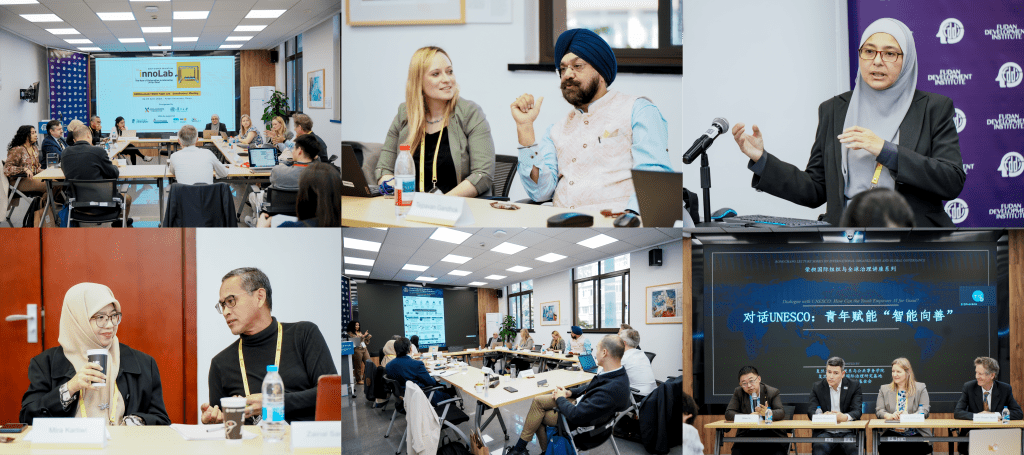
Throughout the week, the ASEFInnoLab7 White Paper Lab coordinators took part in a series of working discussions facilitated with the support of Dr Claudio Rivera, Strategic Advisor of ASEFInnoLab7.
The sessions focused on refining the proposed white paper topics, identifying possible synergies across teams, and discussing the framework, expectations, and guidelines that will shape the months-long drafting process.
The final day of the meeting gave coordinators the opportunity to pitch their refined white paper topics to guest experts Prof Simon Chesterman, Prof John Shawe-Taylor, and Prof Julia Neidhardt. Their feedback helped the white paper leads sharpen their proposals, clarify possible directions, and reflect on key questions around methodology, impact, sustainability, and relevance.
The programme also featured a panel discussion on “Youth Scholars’ Role in Promoting AI for Good,” moderated by Prof Shen Yi. Prof John Shawe-Taylor, Prof Julia Neidhardt, and Prof Lampros Stergioulas shared insights from their work as UNESCO Chairs and reflected on what humane, responsible, ethical, and inclusive AI could mean for today’s AI-permeated society.
ASEF extends its sincere appreciation to Fudan University for hosting the Coordinators’ Meeting and for another successful co-hosting partnership. ASEF also thanks Dr Claudio Rivera, our guest experts, supporting partner organisations, and our stellar lineup of expert coordinators for their thoughtful contributions throughout the week:
- Prof Shen Yi and team (Fudan University, China)
- Dr Yang Bong and Dr Neelima Sailaja (University of Nottingham, UK)
- Prof Daniel Burgos (UNESCO Chair for eLearning / Universidad Internacional de La Rioja, Spain)
- Prof Lampros Stergioulas (UNESCO Chair for AI & Data Science / The Hague University of Applied Sciences, Netherlands)
- Prof Zainal Sanusi and Prof Mira Kartiwi (International Islamic University Malaysia, Malaysia)
- Dr Shalinka Jayatilleke (La Trobe University, Australia)
- Dr João Pita Costa, Ms Anja Polajnar, and Mr Davor Orlic (UNESCO International Research Centre for AI)
- Dr Sharina Yunus (Universiti Teknologi Brunei, Brunei Darussalam)
- Prof Tejpavan Gandhok and Prof Spriha Bhandari (OP Jindal Global University, India)
Following the Coordinators’ Meeting, the ASEFInnoLab7 team now looks ahead to the next phase of the programme: welcoming the wider White Paper Lab cohort and supporting teams as they develop strategic white papers for universities’ role in advancing AI for good.