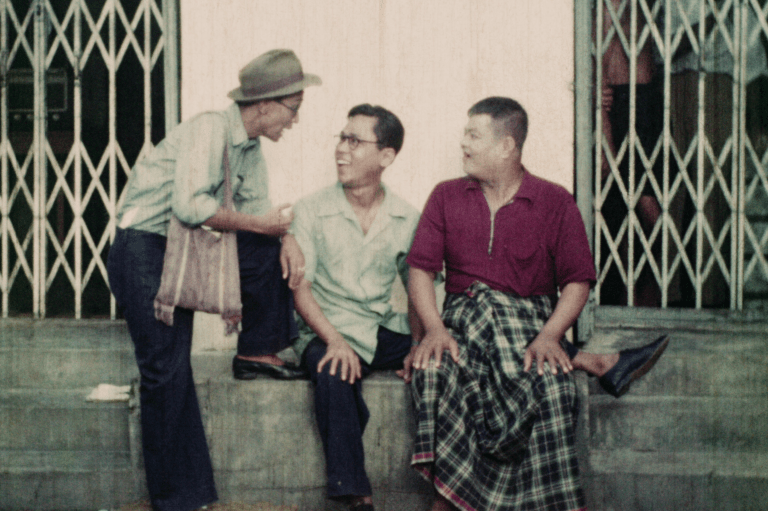
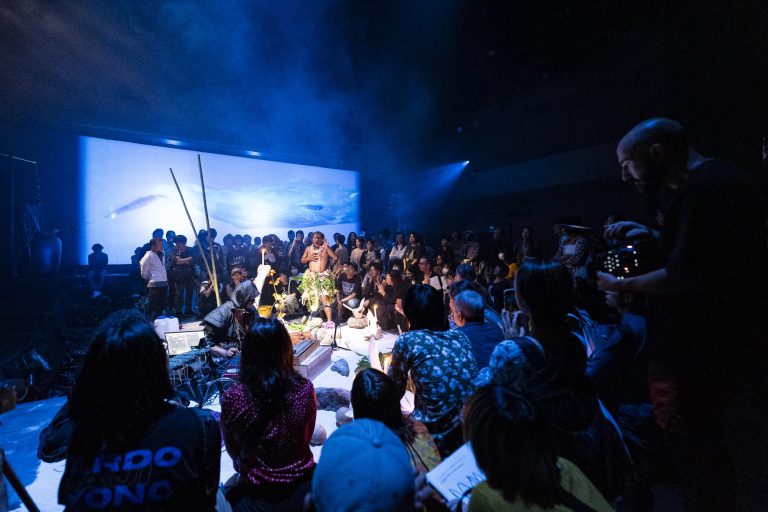
WE SPOKE WITH TIANZHUO CHEN AND SIKO SETYANTO, THE DYNAMIC FORCES BEHIND OCEAN CAGE, A MULTI-DISCIPLINARY AND DEEPLY IMMERSIVE PERFORMANCE, PRESENTED AT THE ASIA-EUROPE CULTURAL FESTIVAL 2025.
In this episode, AECFest Manager Giulia Poli speaks with visual artist and director Tianzhuo Chen and choreographer and performer Siko Setyanto about their work Ocean Cage. Inspired by the ancestral whale-hunting rituals of the Lamalera community in Indonesia, the performance invites the audience into an immersive ritual space that blurs the boundaries between spectatorship and participation. Listen to their reflections on artistic process, ritual, ecology, and the role of audiences — ahead of the work’s presentation at AECFest 2025 in Shanghai, in collaboration with ACT.
Listen to the podcast. Full transcript is available below.
Giulia Poli (GP): Hello and welcome to a special podcast for the Asia Europe Cultural Festival 2025. My name is Giulia and I’m the festival manager. Today I’m joined by two extraordinary artists, Beijing-born visual artist and director Tianzhuo Chen, who is based in Berlin and Jakarta-based choreographer and performer Siko Setyanto. Together they created Ocean Cage, a powerful and immersive performance inspired by the rituals of the Lamalera community in Indonesia, known for their whale-hunting traditions. Tianzhuo and Siko, thank you so much for being here today.
Tianzhuo Chen (TC): Thank you for having us.
Siko Setyanto (SS): Thank you, thank you so much.
G: Tianzhuo, let’s start with you. How did you and Siko first meet and what brought you together for Ocean Cage?
TC: Actually we met in 2019 already, Ocean Cage wasn’t our first collaboration. We already collaborated in TRANCE, another performance we are touring at the moment, in 2019. I decided to make this new performance, and we were trying to do a demo version. I was thinking of a performer to be part of the production. Through one of my friends, I saw a video of Siko dancing, I think just from social media. And from that, like, simple clip, I thought that was the person I’m going to work with. So I asked my friends to call Siko, if he wanted to join the production. That’s from my memory. And then I think Siko said yes. And yeah, I think you were quite shocked that that was a 12-hour performance. But he decided to take that challenge, and so he flew to Beijing and we met together.
GP: That’s very interesting – it’s interesting how meaningful connections can spark the creative process. So Siko, from your side, what was it about this project that made you want to join forces?
SS: Since I got to know Tianzhuo – suddenly I become, what is that, someone that I admire since I was a kid, you know, suddenly I become one of the members of a rockstar group. It’s a really beautiful feeling because as I knew him because of my friend and suddenly wow, ASIANDOPEBOYS had a huge impression for my- myself, for my opinion. And suddenly through these 12 hour, I became someone is new, I guess, because I never been in that kind of situation, a 12-hour performance.
And also, especially with Ocean Gate, I suddenly have the opportunity to create something, starting from scratch, beginning with an Indonesian story, you know, as I knew since long time ago, I don’t know, in 1992 or 93, there is a big story about Lamalera and suddenly, yeah, it’s a such a big honour for me. Tianzhuo reminded me about that, ‘Let’s go there, Siko’, just create something and inspire by their story, their belief and, yeah, in nature and everything. So for me this, yeah, this is very beautiful. It’s sacred, majestic, and Lamalera for me is a phenomena.
GP: Thank you.
TC: Also, I want to add a tiny bit about the background during that time, because the work started in 2022, it was still locked down in China. So we were performing trance together in Berlin and then I couldn’t go back to China, so I decided to fly to Bali to meet some of my friends. That’s how everything started. So I was kind of like stuck outside of China. And then Siko and me decided to use that time to do something together. That’s how it started. So it actually started from the pandemic until now. So that’s the work.
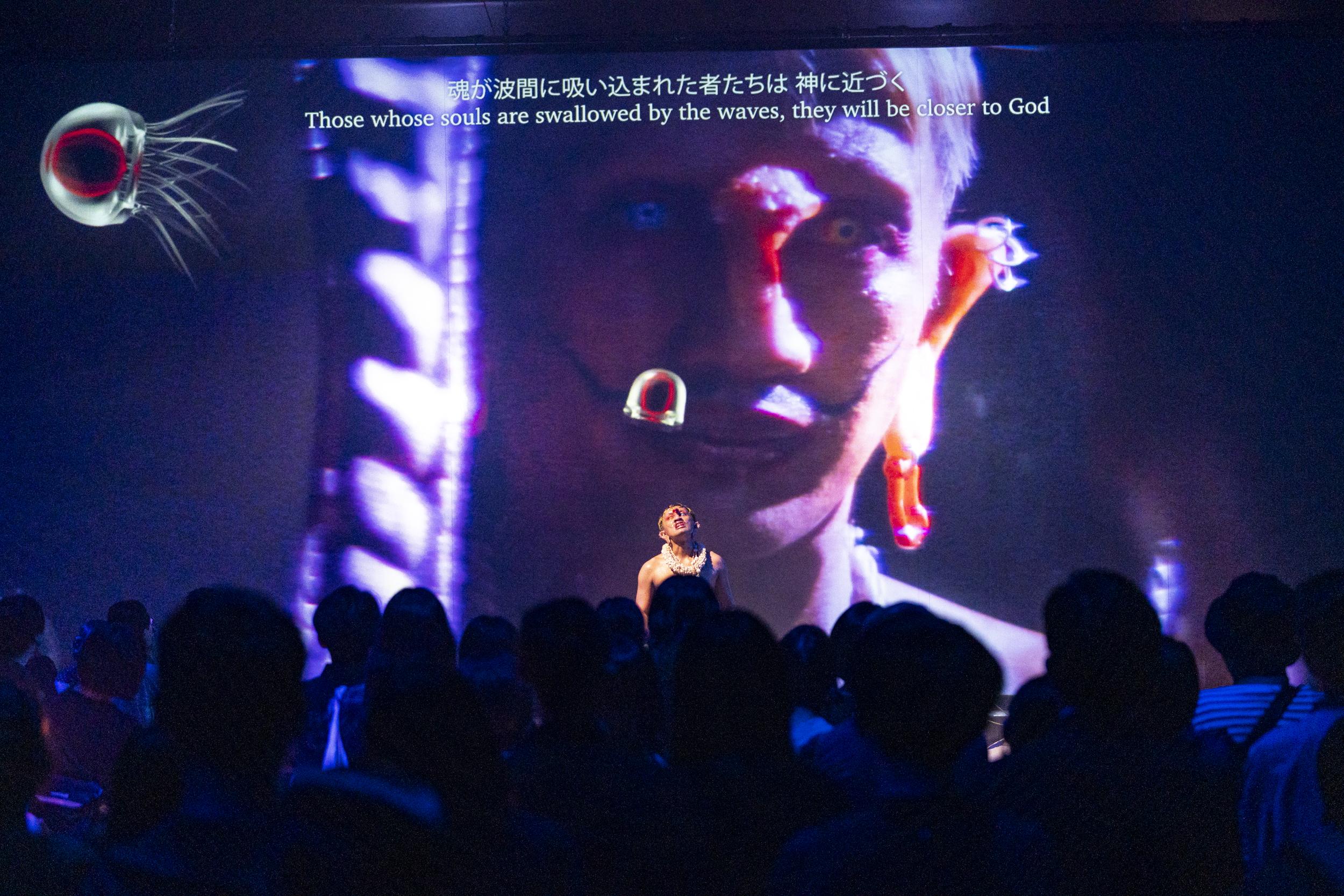
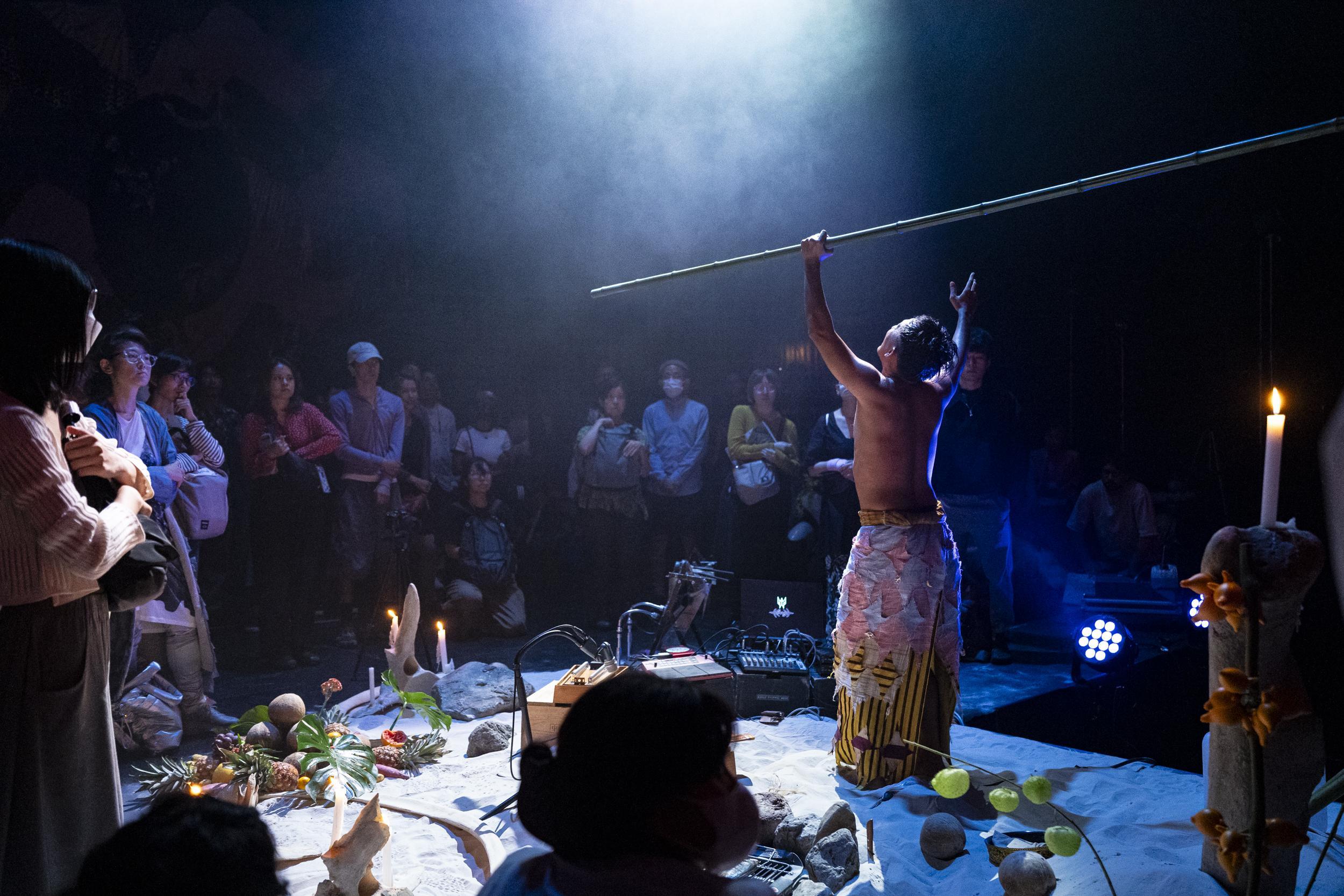
GP: Actually, I wanted to ask you before we dive in into the artistic process to maybe give our listeners some context. So, we know that the piece is inspired by the rituals of the Lamalera community, as you have mentioned. Could you tell us a bit more about who the Lamalera are and what drew you to create a performance around their practises?
SS: Oh yeah, yeah. Since I’m a Javanese, I was born in Java and Lamalera is far away, east side of Indonesia, there, it means I didn’t know, nothing about them. I came from like a kampung (village), small kampung in Java. So that’s why I don’t know about what is that the culture, the seamen culture, something like that. But in our country we have a special song, ‘Nenek moyangku seorang pelaut’ is about ‘my ancestor is a seaman’, something like that. Starting from kindergarten, we knew that, but I wasn’t attached to it like that. That’s why Lamalera for us, for Indonesians, is like very- For me, it’s like very strong characteristic of a village, of a society, because they have their own story about whale hunt, but also the way they control the environment. So this is the beautiful side of Lamalera, in my opinion.
GP: And Tianzhuo, anything from you?
TC: Starting the project, I also know as little as, you know, Siko or even less then, much lesser than Siko about the place. But we just have this idea to witness another way of thinking about this ecosystem, you know, like it was so thrilling to hear the story about the ancestors and how they think the ancestors become a whale to feed the village. Also they pray through the ancestors, as they think that God can hear that better, because the whole village was converted to Catholic in the in the 19th century. So they have this like a whole complete, like ecosystem. Which is through their ancestors, God and the whale, and at the same time, the whale is their prey to feed the village. We wanted to explore that ancestral knowledge and, you know, inspired by this story. As you know, we all know that ancestral knowledge in this modern in this contemporary context is getting lost. Which is happening everywhere, not just Lamalera, but in all parts of the world. So that, which is one of the reason why I think this inspiration, this story is important for us to understand and to learn from it.
GP: Thank you. It really helps us to understand the cultural depth that is behind the work. And I think one of the striking things about Ocean Cage is how it combines so many forms, dance, installation, film and live music. So I wanted to ask you, Siko, your body is really at the centre of the performance, and you embody these ancestors, these mythical figures. So can you share what it was like preparing for those transformations and how you approach the physical and also the emotional demands of the piece?
SS: Yeah. I work always with my intuition. I don’t know. I’m just that simple. I will say, what I like about working with Tianzhuo in Ocean Cage, because of this immersive performance, because suddenly I yeah, I suddenly he bring me back to my traditional performance, dance, ritual- which is immersive. So when I was a kid, we start the performance in front of a traditional market, they just call the people with the music and suddenly everybody gather, make a circle, something like that. And suddenly there is a, there is no boundaries, who is the performer, who is the audience. So that’s, I love that, you know, because I came from, even though I’m Javanese, I came from ballet and jazz background, which is weird. That’s why when this performances start, I work with Tianzhuo, everything is immersive, suddenly it’s like, oh, “This is me, this is what I like, this is what I start to love in this performance”. And when you ask me how to control the like, physically and everything, I don’t know. When we work together in Berlin, for rehearsals, Tianzhuo is like scratching everything with paper or something like that in the studio and, I was realising, day by day, Tianzhuo put all the material, words, everything and my brain, my body, everything, my cells of my body are talking together. “OK, when you become a seaman, OK, maybe you, your body should be like this. When you be like a God- Yeah, I want to be a God. Maybe God is us also…” something like that. That’s all. I don’t know. It’s a beautiful question, but so difficult to answer.
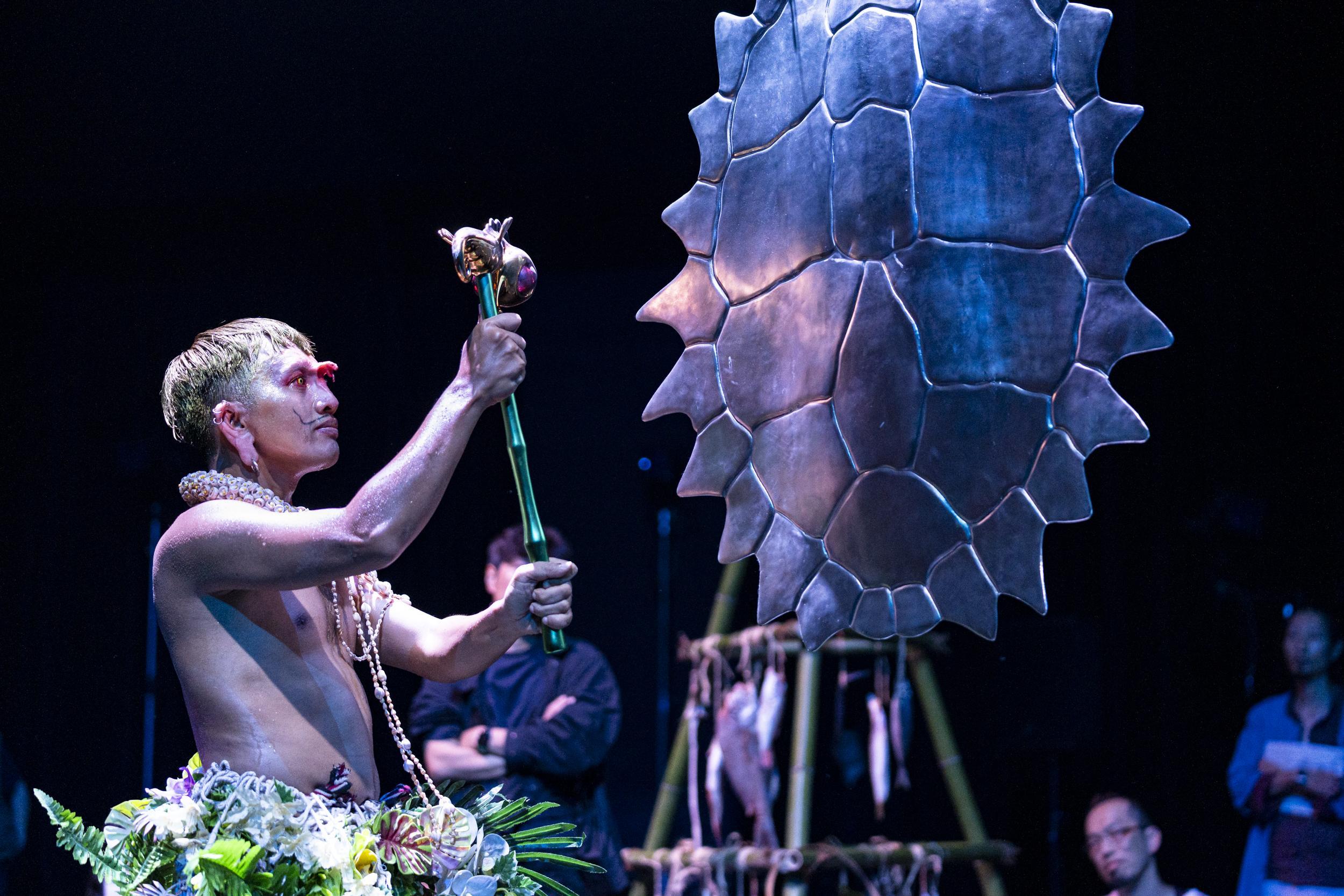
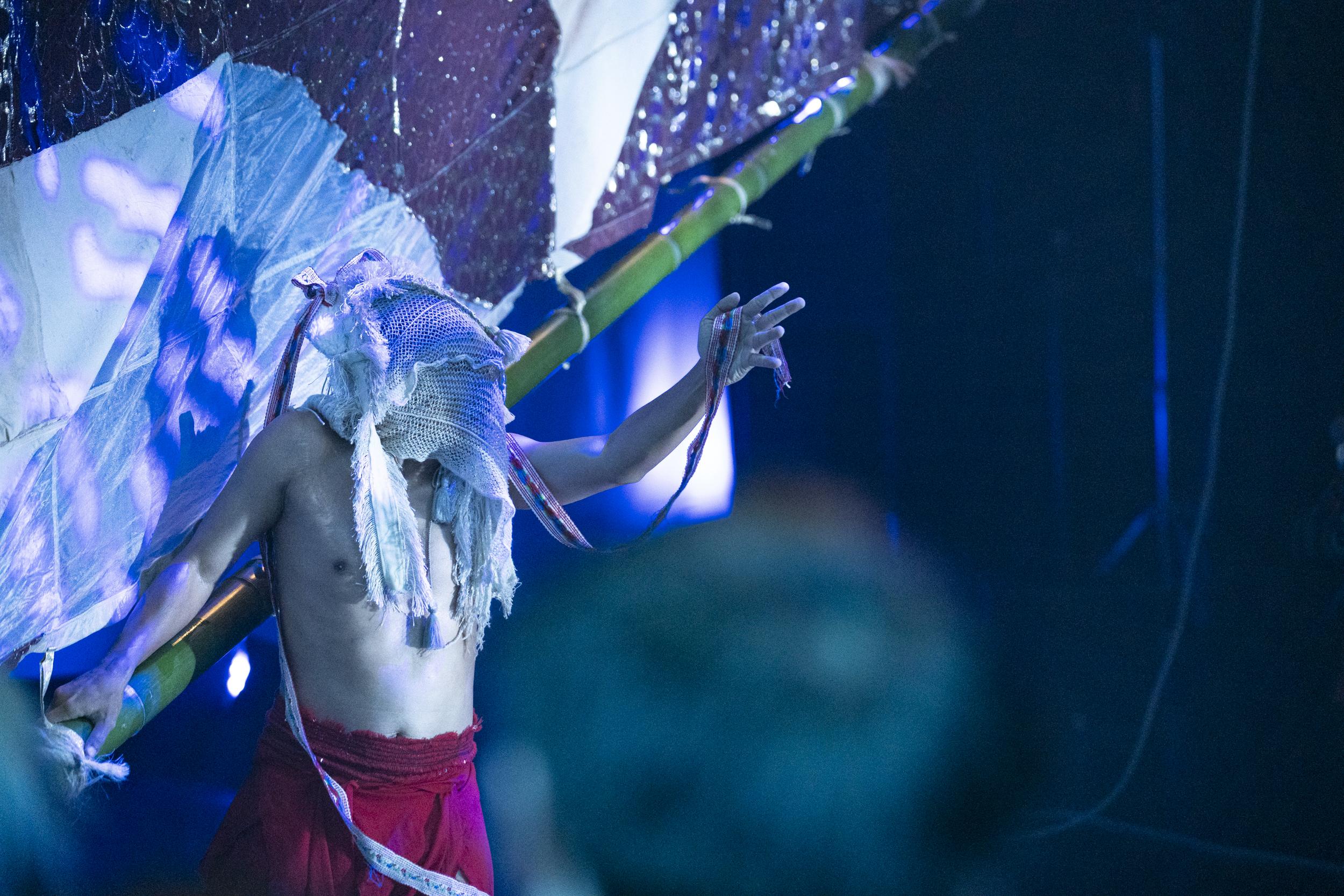
GP: And I wanted to ask how did you approach shaping this hybrid performance language that has spatial elements and it’s interactive and so on?
TC: I think one of the reasons is that I don’t come from a theatre background. So I work a lot with videos and I used to work a lot with the installations.Then I start making performances.I think for me, that I couldn’t handle myself sitting in the theatre for very long time and that’s my problem. So I don’t want my audience have the same suffering in my own performance. So I want them to move free, to sit anywhere they want, and to be really close to the to the performer. Because also like in the art gallery, a lot of objects was being displayed in the white box and the performer, like I hate these performances in the art gallery, you know, like people treating the performer as object, you know, watching them without, without any expression and just, you know, like a civilian or whatever. So I want, I want my performance to bring back this nature of, as if you are in a ceremony or in, I don’t know, like anything that you can actually get close to the performer and, you know, being part of the part of the ceremony, being part of the performance, be able to emotionally attach to the performer, like really, you know, getting close to each other. That’s the whole idea. And of course, in the same vein, Ocean Cage was built around Siko, so all the character, I was imagining as if how Siko should move in this situation and all this stage prop was served for his character and then, how to bring audience together to attach with his performance and attached to Seiko. It’s his intuition, in a way. So there’s like no certain rule of movement or as we call, choreography. You know, that things that he has to follow, but he’s like, I also like that improvising part with audience. You know that you can’t predict, or replace with a different audience. They have different dynamics and different way of interacting with audience. Some audience are more shy, some audience are more engaging.
GP: I think that the piece really engages with the audience in ways that kind of evoke like a ritual participation. Somehow it is really like ceremonial and immersive. And you were mentioning about the audience being so close to Siko, right, so I wanted to ask you: how does this proximity shape your performance and the energy of the peace itself?
SS: Yeah, I consider the audiences to be a very important partner when we perform because for me they are the, the most important in this performance because sometimes they become a ocean, sometimes they become peoples, sometimes they become- anything. Sometimes they become like an obstacle, sometimes they become- anything. That’s my brain. Like Tianzhuo said every stage is always different. Every, I mean country with their own behaviour is different, which is so beautiful. It means in the middle of performance. I still keep learning, keep studying. And me as a performer, I have a strong discipline to handle it. I will not like lose focus for even one second. That’s why, wow, it’s even, I mean, I’m loose in the choreography, non-choreography, like very tight choreography, but the choreography itself is how I work together with the audience, because in my brain and my body, everything I should pay attention with my musicians because they play music together with me and all my backstage friends. Also the video, I should pay attention, because everything is connected. So yeah, it’s similar, I mean similar like in traditional ritual in Indonesia, everything is, should be like, you know, one. Centre, something like that.
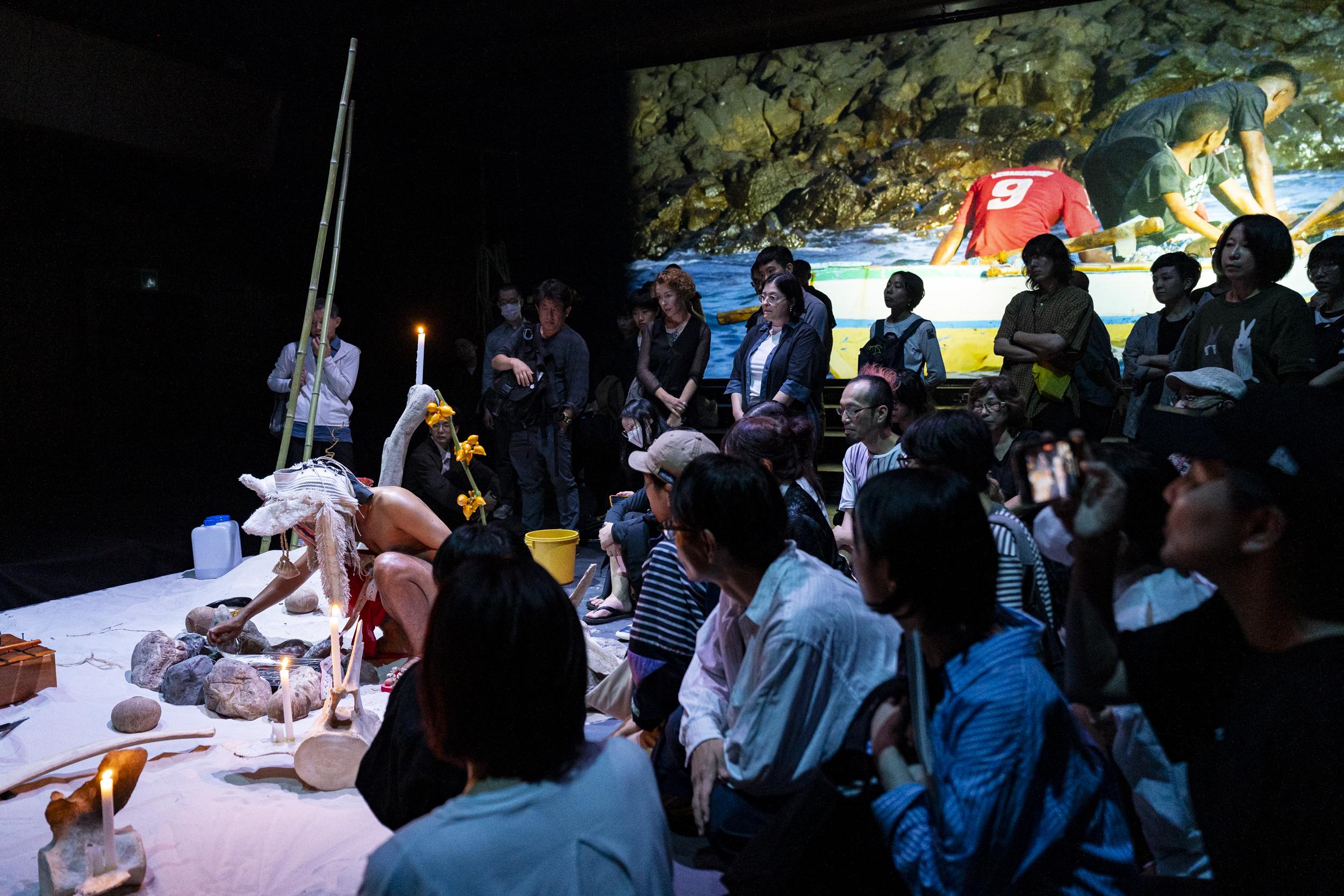
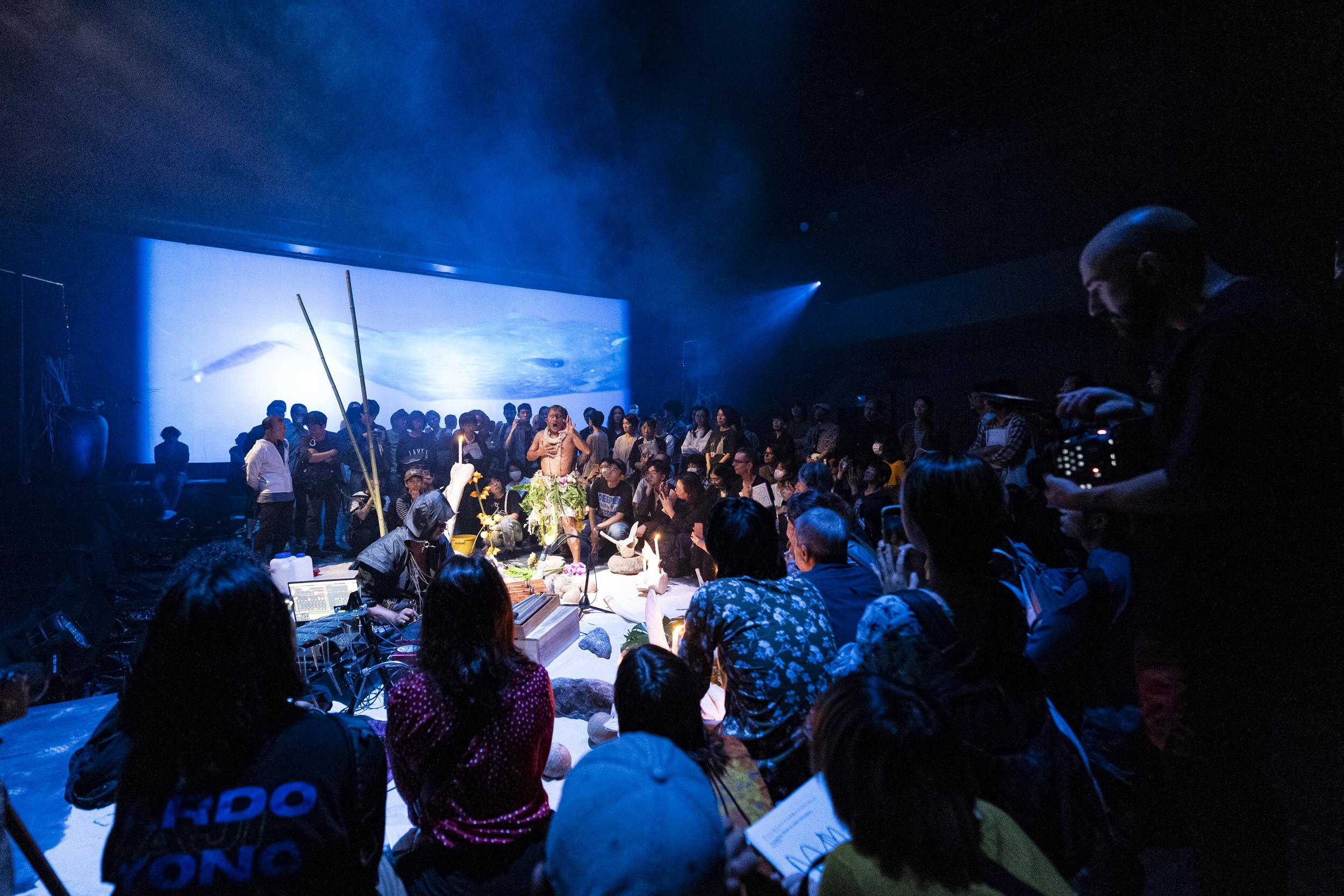
GP: I have to say I’m so excited to experience it live myself! But I also wanted to ask you about some reflections on the ethical dimension of the piece because it also raises broader questions about ecology, sustainability, and also our relationship with nature. So how do you both navigate these global concerns in your work and what do you hope audiences will take away from this reflection?
TC: For me, I think the whole story, like the reference of Lamalera, and how they, how they think of the ecosystem, it unfolds, a story from their ancestral past that, you know, they, I thought that’s this how they unfold a story of other than human perspectives. There is this whole lot of other element engaging in the story like the God, the ancestor, the whale and they call the Whale of the blessing from the God. And they put our, you know, our traditional thinking, like human-centric thinking to the other side. And we are now trying to, you know, judge what is right or what is wrong, and we are also now in the position of questioning their ancestral past and their activity. We were just raising a broader question: “What if there is another way to learn from our ancestors?”
And you know, like today we’re talking so much about like how we learn from AI and how we learn from, you know, what AI makes possible for our, our humanity. But, what if, you know, we’re looking back and learning some knowledge from all this hidden ancestral knowledge instead of always trying to ask ChatGPT, and you know, this what I think.
SS: Personally, through this, our project work Ocean Cage, I prefer to prioritise the Lamalera phenomena in a different point of view. I respect the big issues and global concerns, but I mean, me as Indonesian, when I start to dig in more and communicate with Tianzhuo about Lamalera and suddenly I got a lot of information about them, how they respect the nature, how they have their certain rules, they have their own law about how they control nature, which is, maybe, outside of Indonesia or even inside of my country, this will be something difficult or maybe and also beautiful to understand. And maybe they want to come here, to come to Lamalera, to understand more about their situation, the way they keep their culture. So I’m not a tourist agent. But I don’t mind also if they always ask me about, “do you live there?”, no, I don’t mind to say that I’m not. But with this fictional performance, I hope there is awareness, because in my country there is also a big problem. This side is always left behind. So that’s why, I’m a Javanese, so I want to keep the awareness, still in a good position.
GP: To close, let me ask you both one final question, so if you could leave audiences with a single thought or feeling after experiencing Ocean Cage, what would it be?
TC: I think I already touched on that question, in the previous questions. Basically is that, you know, just this whole, I forgotten knowledge part that I mentioned, but also in the same way I would want the audience to just come enjoy the performance and be in the present. And I think this is the most important thing that, you know, that the audience was there and they experienced the emotion and, you know, feel the narration that Siko unfold on the stage, and be in the present and emotionally engaging with the performance. Instead of, you know, thinking about what they should have taken away or trying to contextualise the idea, that is not an important thing. So being in the moment and it’s the most beautiful part for me.
SS: For me, Ocean Cage is just a 100-minutes performance. So just be simple, just come with your loved ones and holding hands together and be part of us. And yeah, after that, you just drink your beer, wine, good dinner, just like that. This is just performance. Enjoy your performance. Even you don’t like it, it’s OK for me. Just as simple as that.
GP: Thank you to both of you.
TC: Thank you.
GP: So unfortunately, we have come to an end. Thank you so much for sharing your insights and for creating such a powerful work. And for our listeners, Ocean Cage will be presented in Shanghai this October as part of the Asia-Europe Cultural Festival 2025 in collaboration with ACT. Thank you to both of you for having been with us.
Tianzhuo Chen (TC): Thank you.
Siko Setyanto (SS): Thank you.
Giulia Poli (GP): And for the audience, if you’d like to know more about the performance and the artists, we will include the links in the episode. Thank you for tuning in. And we look forward to seeing you at the festival.
Tianzhuo Chen has established a distinct voice in contemporary art through an eclectic and multidisciplinary practice that encompasses performance, installation, video, photography, and works on paper. Through his work Chen persistently reflects on the absurdity of life and death, offering a profound meditation on existence that resonates long after the initial encounter.
Siko Setyanto is a dancer and choreographer from Jakarta, Indonesia. He chose dance as a means of expression, opening the opportunity to work extensively in multidisciplinary arts. Siko began his training at the age of nine with Wied Sendjayani at the Sanggar Maniratari, Solo. In mid-2020, he co-founded Dansity Dance Company. He has been a member of the Jakarta Arts Council Dance Committee from 2020-2023.
Cover photo: Ocean Cage © Partner in Crime
Get your tickets for Ocean Cage at the Asia-Europe Cultural Festival 2025 here (EN) or by scanning the QR code below with your WeChat app (CN):

Discover the full AECFest programme.
SHARE THIS ARTICLE