WE SPEAK WITH CALLIGRAPHER, AOI YAMAGUCHI, ABOUT CALLIGRATON - HER LATEST WORK AND COLLABORATION CRAFTED WITH ELECTRONIC MUSIC DUO, SCHNIT, AND PRESENTED AT THE AECFEST 2025 CLOSING CURTAIN IN SINGAPORE.
1. In this unique collaboration with music duo, SCHNITT (Amelia Duchow and Marco Monfardini), traditional Japanese calligraphy meets contemporary and experimental electronic music. Could you share more about how this partnership first began and what sparked the inspiration to unite these two art forms that, at first glance, seem distant?
In May 2024, I received an email from Schnitt. It said that they were interested in collaborating with me, to create a live performance based on interaction of my calligraphy art and their sound art. I’ve looked at their work, and I held my breath. Their visual works in minimal lines, black and white in a monochromatic color scheme, and minimal yet deep resonance of their soundscape — I immediately replied, yes. I have been a big fan of experimental electronic music and audiovisual performances, and not to mention, I have been dreaming of collaborating with audiovisual artist integrating projections and sound into my live calligraphy performance. Without a doubt I thought we can create something amazing together. We have so many mutual friends in the music field, and we have so many things in common — it is serendipitous how our path crossed — I truly believe that we were meant to meet in our lifetime.
Over the course of a year, we’ve discussed about how we could collaborate together. We brainstormed about formats and approaches. When I create a new artwork, I start from thinking about concept and theme, and that is derived of words, characters, and the meanings. For our collaboration, Calligraton, Schnitt composed sound and created live visuals inspired by my calligraphy performance to weave together with my live action, translating the dynamic movement and circulating energy of Shodō. We sat down together to talk about each sound composition is about, what the visuals each depict, and I chose a zen phrase that consists of five characters that symbolize each phase, and together as a whole.
2. This is not the first time you’ve paired your art form with music. In TWELVE (2022) you performed live calligraphy alongside European piano classics, and in UNiBIRTH (2012) you collaborated with an Argentinian contemporary composer. What has your experience of cross-cultural collaboration been like? As an artist, how does your practice evolve or adapt when working within new and diverse cultural contexts?
Music is one of the crucial components in my live calligraphy performances and in my creative process, and the source of inspiration. Music has been another passion of mine since when I was little — I learned piano from the age 5 for 10 years, and I studied the music industry in college in the early years. While I was studying calligraphy since the age of 6, I got into dancing jazz, hip-hop, and house, also a bit of breakdancing since high school. To me, music, dance and calligraphy art are very much intertwined; they are all different artistic human expression in different forms, and inspire one another.
Since I was little growing up in rural town in Hokkaido, I love writing my own poems inspired by music, nature, seasons, landscapes and various emotions. When I listen to a melody of a piano, words and visions just sparks through my head, and I see dots and strokes of calligraphy dances to the rhythm, different colors, sceneries, and stories in those soundscapes. Those words, phrases, characters and visions become the material for my art. For the performance TWELVE (2022), I selected 12 classical piano pieces that I hold dear, as I was exploring through the fragments of memories from my childhood in Japan to where I am now in the United States. I selected a Kanji character represent what it evokes, and then I put them in an order as if I’m compiling an album to tell a story of my life. It begins with “醒” (Awakening) inspired by Préludes / Book 2L123; Bruyéres by Claude Debussy, and then flows into the phase of “奔” (Run), inspired by Polonaise No.6 in A-Flat Major, Op.53, “Heroic” by Frederic Chopin. For the part of struggles and challenges, “綴” (Written) for Clair de Lune by Claude Debussy, and then to the phase of seeking self, “瞑” (Closed Eyes / Meditate ) for Moonlight Sonata by by Ludvig Van Beethoven, and it concludes with “逢” (Encounter), inspired by Liebeatraum, S.541, No.3 by Franz Liszt.
Music is an universal language. When creating a collaborative art piece, we see, listen, understand, and feel each other beyond cultural differences or language barrier. Then we exchange expressions using different media, and weave them together. I take various approaches to create a performance piece with music; one approach is that I listen to a piece of music that is already recorded, and inspired by that sound soundscape, I choose words or I compose poems. Another approach is that I write a poem or choose Kanji characters, and I hand them to the composer, and the composer would compose music inspired by those words. That was how UNIBIRTH (2012) was created — I wrote a poem which has 3 parts. The composer and the contemporary dancers and I got together in a studio to go over the flow and improvise, and the composer wrote the music inspired by our shared visions, and then we performed live together. In these creative process, we are translating one form of expression into another form of expression. It is like we are having a conversation without verbal languages, and each voice come together into one.
I love collaborating with artists from different cultural background, because I can listen to, feel, or see, who they are — their upbringing, personality, emotions, passions, energy, and their cultural influences — naturally reflected in their sound, whether through live instruments, like piano, cello, flute, accordions, taiko drums, shamisen, or digital sound compositions, and that inspire me more than anything.

3. In an era dominated by texting and typing, where the practice of handwriting is rare, what does the fusion of tradition and modernity in Calligraton reveal about the evolving role of traditions and the arts in contemporary society?
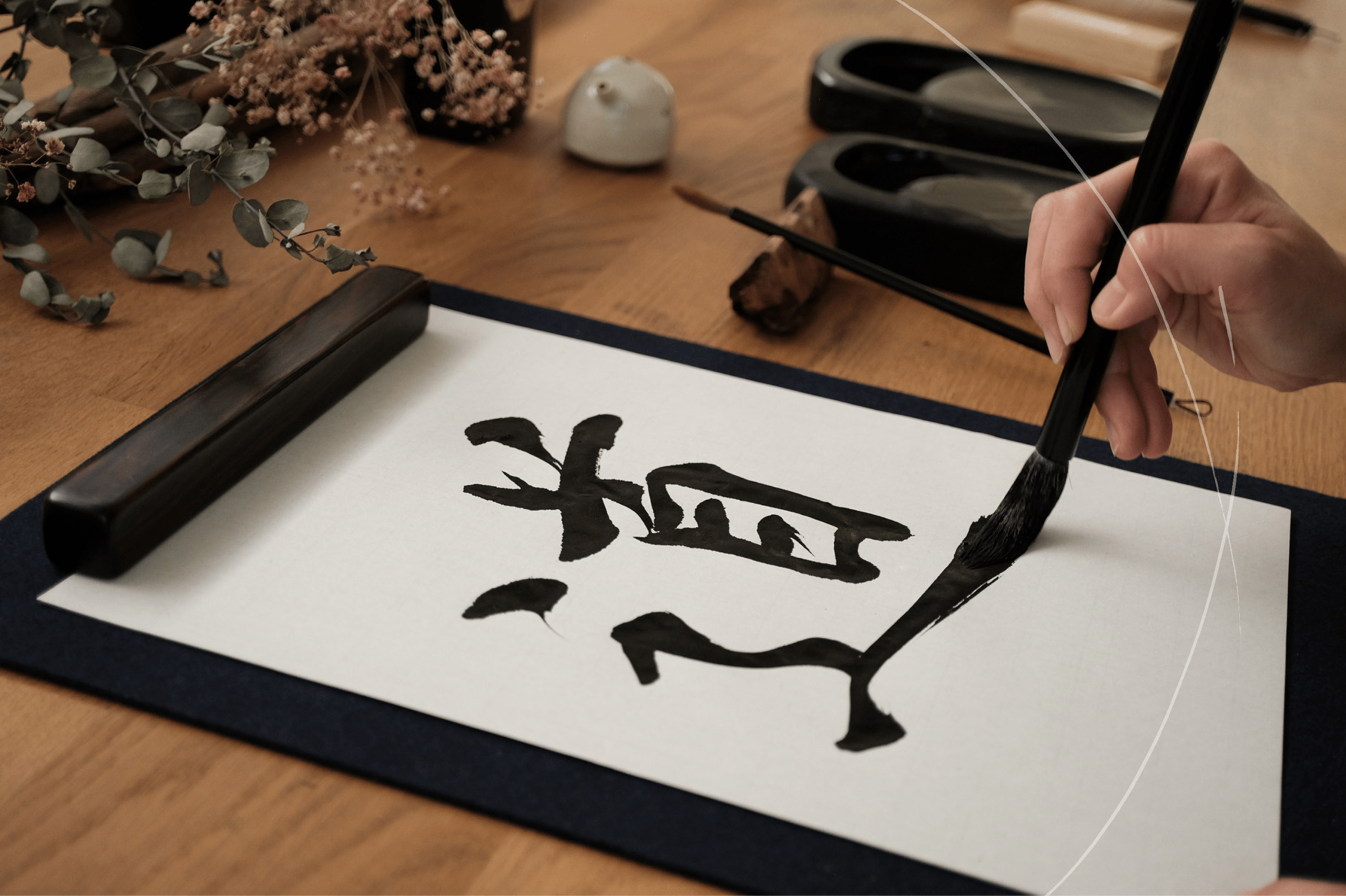
Rather than appreciating the art of calligraphy as a two-dimensional work of art, Calligraton is a work that allows viewers to experience the beauty and drama of life and movement that lies in the process itself. In today’s society, where everything moves at a faster pace, calligraphy teaches us the importance of slowing down, and the preciousness of putting thought into each and every line. In a world where you can’t simply copy and paste or redo, you have one chance to focus on that one piece of paper, calm your mind, regulate your breathing, and put everything you have into it. The act of writing by hand is self-expression itself, and the writer’s mind, their spiritual world, is infinitely deep and unfathomable even to the writer. By writing, one can see the inner mental landscape of one’s own mind, like a mirror, in the traces of brushstrokes.
As one of the traditional art forms that has been practiced since the 6th century, Shodō still holds a significance in our culture and today’s society as a means of lifelong learning, discipline, education, practicing mindfulness, and as a pure plastic art. As a calligrapher, I respect the forms that have been passed down since ancient times, and I want to convey its beauty in the right way. That’s why I want to compete in the world of black and white. I believe that the infinite possibilities of calligraphy lie in the fact that, using the fundamentals I learned from my master and traditional methods, I can express in my own way the world I want to express, the lines I want to pursue, the sounds and light I want to be enveloped in, as an individual who lives in this modern times. Just as words and characters have evolved over time in the past 2000 years, the methods of expression in calligraphy will also evolve, and I want to keep challenging to push that boundaries.
4. As your performances weave together sound, movement, and image, they create a space for audiences to experience art in a very multi-sensory way. Looking ahead, what lasting impression or reflection do you hope people carry with them after encountering your work?
In this performance, you can see that calligraphy is everything about “being” — silence, motion, space, time, the universe, and yourself. It begins with a meditation and centering yourself into the very present moment, visualize, and expressing through the brush, each stroke is the trace of your life in that very moment, beating and breathing. You will see that the calligraphy has its own rhythm, just like a dance. The brush moves in a certain order and it flows as if a musical note flows from one to another, up and down, thick and thin, weak and strong, fast and slow. Writing, ultimately, is a form of self expression. When using a brush and ink on a blank white piece of paper, the story can be told in a monochromatic landscape in the most minimalistic way, which can leave you with the powerful impressions and emotional experience.
I hope you will be immersed in this journey of diving deeper into your inner self. You could also meditate, breathe, and dance with us – and reflect on what it means for you to be fully “present” in everyday life.
Aoi Yamaguchi was born and raised in Hokkaido, Japan, training in the fundamentals of calligraphy under the guidance of Master Zuiho Sato from the age of six, continuously refining her skills and knowledge. She has exhibited and performed her works in numerous theaters, museums, galleries, universities, and festivals across the U.S., Europe, and Japan. Her work explores the juxtaposition between traditional Eastern classics and contemporary artistic expressions, along with her unique ambition to transform the two-dimensional art of Japanese calligraphy into a form of physical expression through performance.Yamaguchi continues to develop her conceptual calligraphy installations, exhibitions, and performances, constantly pushing the boundaries between traditional Eastern calligraphy and contemporary artistic expression.
Cover photo: Aoi Yamaguchi Performance for Canada Goose SS19 Nomad Capsule Collection Campaign © ph Kageaki Smith
Get your tickets for Calligraton here. Tickets are free with registration. A SGD 10 deposit is required to secure your seat and will be refunded upon attendance.
Admission: General
Discover the full AECFest programme.
SHARE THIS ARTICLE