
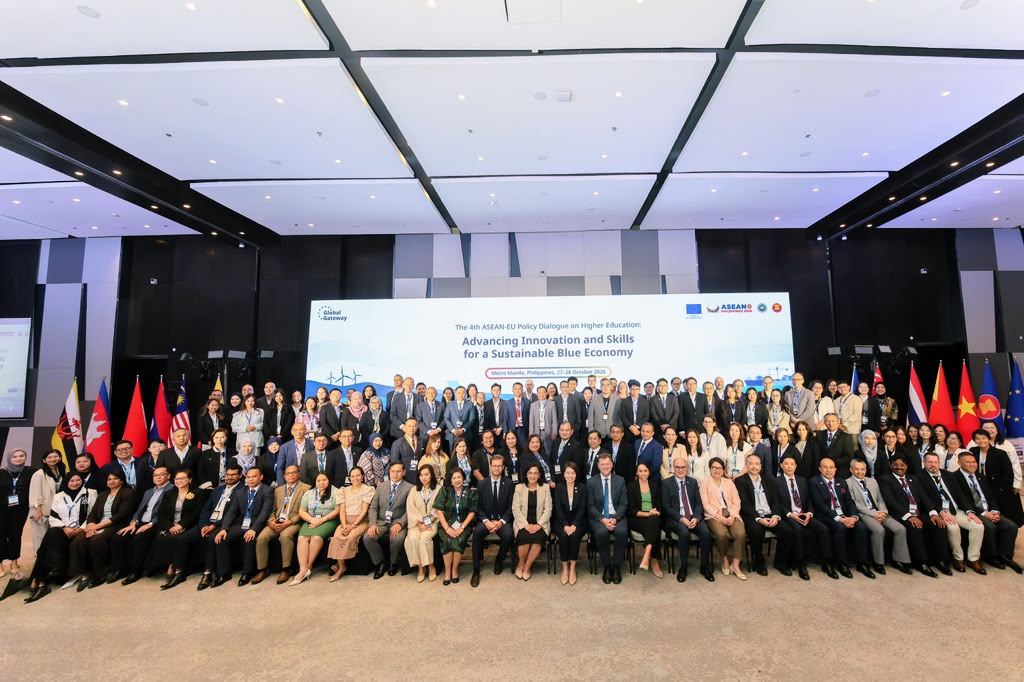
The 4th ASEAN-EU Policy Dialogue on Higher Education, held on 27-28 October 2026 in Manila, Philippines brought together representatives from governments, higher education and TVET institutions, international organisations, youth networks, and other stakeholders to explore how education and skills development can support a sustainable blue economy. The dialogue, themed “Advancing Innovation and Skills for a Sustainable Blue Economy,” focused on strengthening the contribution of higher education and training to blue and green talent development.
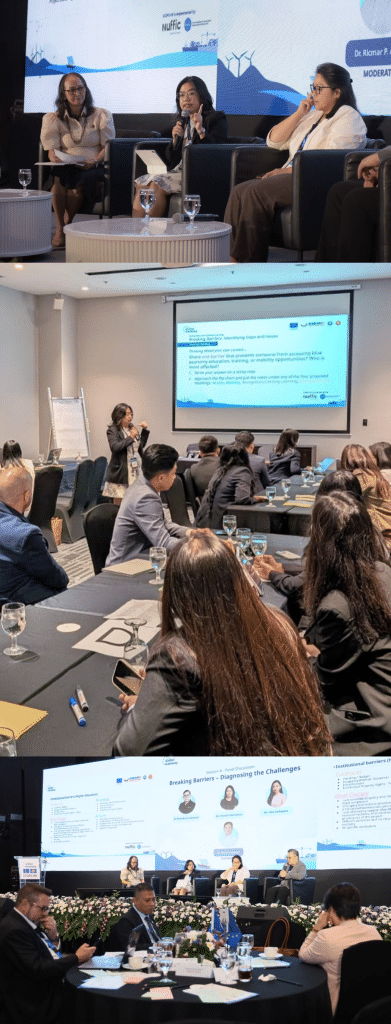 Across the plenary sessions, speakers discussed priorities in ASEAN and Europe related to the blue economy, green and digital transitions, human capital development, mobility, qualifications, and stronger links between education and industry. They also spotlighted how education systems can respond to emerging skills needs while ensuring that new opportunities remain accessible to learners from different socioeconomic and geographic backgrounds.
ASEF contributed to the dialogue through the facilitation of the parallel breakout session on Inclusivity and Lifelong Learning.
Cleo Cachapero, Project Lead for Higher Education at ASEF, guided a mixed stakeholder group comprising government and intergovernmental representatives, university officials, and youth leaders. The session was designed as a diagnostic discussion, with participants identifying barriers affecting equitable access to blue economy education, training, mobility, lifelong learning, and participation in policy processes.
Several recurring gaps emerged:
- Participants highlighted how geography, affordability, and uneven infrastructure continue to restrict access to education and training, particularly for young people in rural and isolated communities
- Limited digital connectivity, shortages of qualified trainers, and a lack of locally available programmes were cited as compounding barriers.
- Mobility opportunities were also seen as unevenly accessible, with cost constraints disproportionately affecting lower-income learners.
- Discussions also surfaced weaknesses in the recognition of non-traditional and lifelong learning pathways. While alternative forms of learning may be available, participants noted that their value can remain limited when credentials are not formally recognised, progression routes are unclear, or employers do not provide sufficient time and support for continued learning.
- In addition, participants raised concerns about limited and sometimes tokenistic representation of marginalised groups in decision-making processes.
These findings were subsequently brought into the plenary discussion and helped frame the shift from diagnosis on Day 1 to solution-building on Day 2. The dialogue ultimately emphasised that advancing the blue economy will require not only new skills and programmes, but also learning systems that are accessible, flexible, recognised, and inclusive of the communities they are intended to serve.
We are grateful for the opportunity to contribute to this dialogue and congratulate the EU-ASEAN Sustainable Connectivity Package – Higher Education (SCOPE-HE) Programme team as well as the Commission on Higher Education (CHED), Philippines for a successful event.
We look forward to seeing the discussions carried forward through the Manila Policy Brief and future ASEAN-EU cooperation in higher education.