
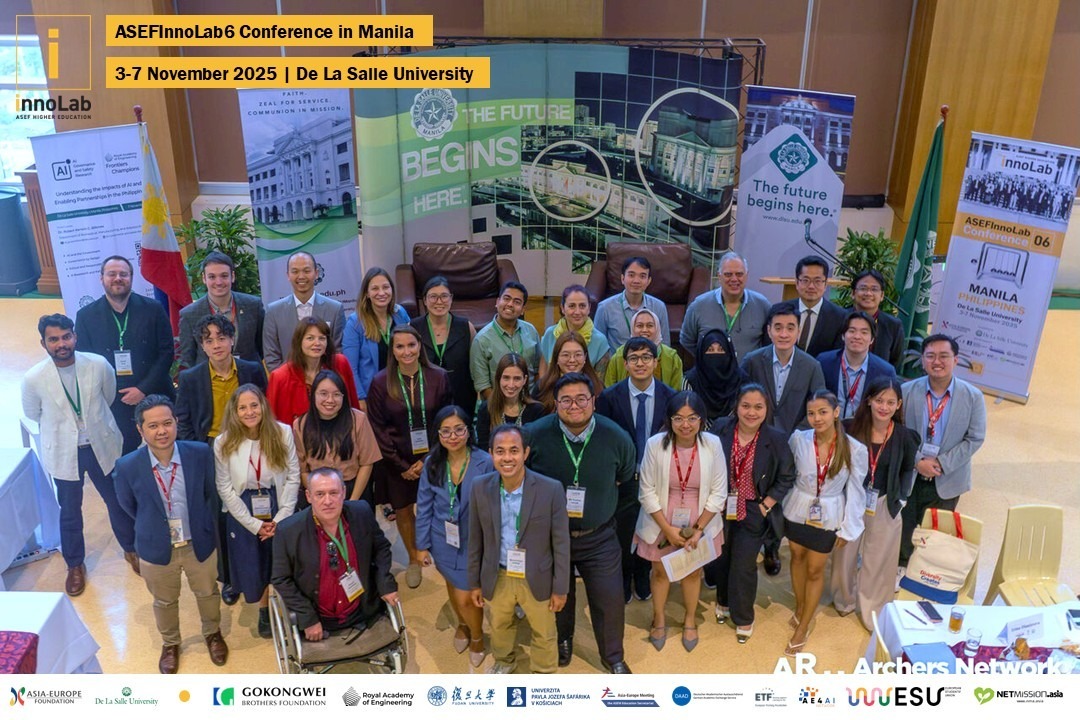
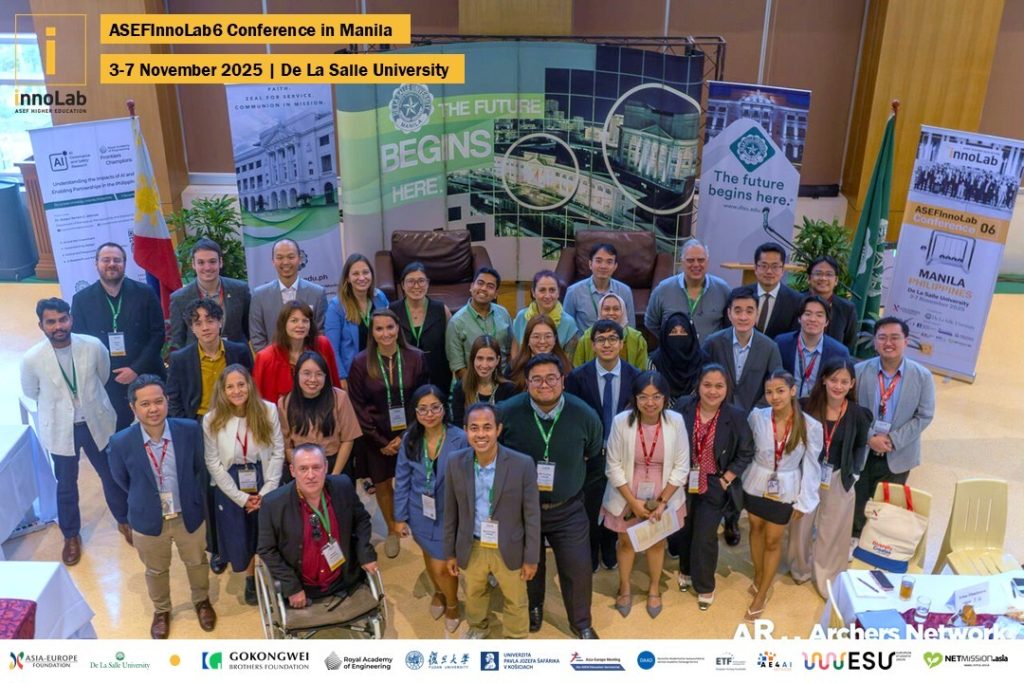
The 6th ASEF Higher Education Innovation Laboratory (ASEFInnoLab6) Conference in Manila, Philippines was held successfully on 3-7 November 2025 in partnership with our implementing partner and host, De La Salle University.
The conference convened 25 higher education professionals and academics from 21 countries, all working collaboratively to design micro-credential programmes that respond to the evolving skills demands of the AI era.
Opening Day: Framing Universities’ Role in an AI-Driven Society
We had a great start with a series of welcome messages from the following speakers:
- Mr ZHANG Lei, Deputy Executive Director, Asia-Europe Foundation
- Dr (Anthony) Shung Fung CHIU, VP for External Relations and Internationalization, De La Salle University
- [Online] Dr Shirley AGRUPIS, Chairperson, Commission on Higher Education
- Prof Dr Alvin Culaba, Commissioner, UNESCO National Commission of the Philippines / De La Salle University
Collectively, the speakers underscored the critical role of universities as societies navigate rapid AI transformation, while highlighting the Philippines’ strong commitment to ethical, inclusive, and human-centred AI in education and national development.
An insightful multisectoral panel discussion moderated by Dr Robert Kerwin BILLONES also took place on the opening day, featuring voices from the youth, government, academe, and industry:
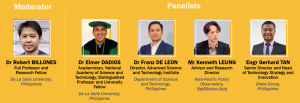
The discussion emphasised the importance of cross-sector collaboration for AI-enabled national development, the role of young changemakers, universities’ evolving relationship with technology, and the urgency of ensuring AI benefits underserved communities amid a widening digital divide.
Keynote Insights: Skills, Ethics, and Lifelong Learning in the AI Age
 On Day 1, Dr Shanti JAGANNATHAN (Director for Education, ADB) urged proactive policy, cross-disciplinary learning, and Asia–Europe collaboration to harness AI’s benefits while managing risks so learners thrive in an AI-powered future. GenAI is moving fast, and universities must rethink constructive alignment to close skills gaps and ready adaptable graduates.
Day 2 featured back-to-back keynotes from:
- Dr Salvatore MOCCIA (Director of Education & Skills, EIT Digital), who highlighted the importance of co-designing programmes with industry, cultivating “natural intelligence” (ethical judgment, adaptability, and interdisciplinary thinking), and reaffirming universities’ human-centred, common-good mission..
- Prof Dr Daniel BURGOS (Vice-Rector for International Research, UNIR), UNESCO Chair in eLearning, who emphasised that learning in the AI era must prioritise inclusion, equity, and human oversight, guided by principles such as transparency, social contribution, and sustainability.
On Day 3, perspectives from lifelong learning leaders further grounded the discussions:
- Dr Kian Hoong KWAN (Director, Temasek SkillsFuture Academy), shared how Singapore’s ecosystem builds trust, stackable learning pathways, and credential literacy. His talk emphasised that the real innovation lies not in technology, but in fostering a culture of lifelong, skills-based learning.
- Dr Rowena CAGUIAT (Director, DLSU School of Lifelong Learning), showcased DLSU’s micro-credential programmes and their unique value proposition in the Philippine context, highlighting their flexibility, accessibility, and relevance for diverse learners.
Designing Micro-credentials for Real-World Impact
Throughout the week, teams presented micro-credential programmes-in-development, each addressing emerging skills needs in an AI-driven world:
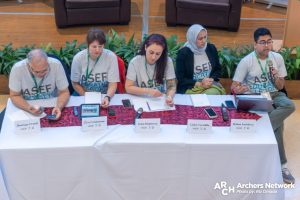
- “Micro-credential for Real-Life Learning, Supporting Lifelong Learners Beyond the Classroom”, presented by the team of Nutan BALLA (Malta Further and Higher Education Authority), Agata KROLIK(BlueSoft (Orange Group)), Vitaliy RUDNEV (Kostanay Regional University), and Yang BONG (Nottingham University)
- “Living AI: A Sandbox for Tomorrow’s Applications & Today’s Improvements”, shared by Liwah WONG (Technical University of Berlin), Bin ZHOU (University of Augsburg), and Harisa SHAHID (NetMission.Asia)
- “Accelerating Digital Research Methods in Higher Education: Ethical and Practical AI Integration”, by Mohammad ROKIB (Universitas Negeri Surabaya), Dechkunn CHHAY (Cambodia University of Technology and Science), and Kristaline LEYTE (Eötvös Loránd University)
- “AI & Digital Ethics: A Micro-credential Program for Responsible Innovation & Trustworthy AI” presented by its members joining onsite Julia EISNER (University of Applied Science Wiener Neustadt), Aviral KAINTURA (National Forensic Sciences University / NetMission.Asia), and Nang Thaingi MYO (UNESCO Myanmar)
- “Fraud Risk Management: Theory and Practice in the AI-Powered Higher Education Environment” presented by its members joining onsite Kenneth LEUNG (NetMission.Asia), Karol LEJA (Tampere University), and Hoang Ca PHUNG (FPT University)
- “Digital Transformation and Industry 5.0: A Joint Contribution from Asian and European AI (Augmented Intelligence)” by Henrique O’NEILL (ISCTE – Instituto Universitário de Lisboa), Rohan SACHDEVA (La Trobe University / NetMission.Asia), Irina DIMITROVA (Human Resources Development Center), Ieva VIEDEMANE (RTU Riga Business School), and Lidya VERADILLA (Nuffic Southeast Asia)
- “Incorporating AI Tools in Teaching and Assessment” presented by members joining onsite Md Shafiee YAKOB (Universiti Brunei Darussalam) and Jo Ann MAGSUMBOL (Polytechnic University of the Philippines)
The Micro-Credential (MP) Track was guided by Dr Lara SORRENTINO (University of Florence), whose expert facilitation supported teams through iterative workshops, peer learning, and targeted feedback sessions.
Bridging Theory and Practice: Industry Engagement in Action
On Day 2, participants engaged directly with industry-led applications of data and AI. The visit began with insights from Dr Briane SAMSON, Executive Director of the Andrew L. Tan Institute of Data Science, who highlighted how data-driven solutions are being applied to urban planning, transportation, and public health in the Philippines.
The cohort then visited Megaworld’s Integrated Town Management Corporation Command Center, where Mr Francis VIERNES, Chief Data Scientist, demonstrated real-world applications of advanced technologies in urban management.
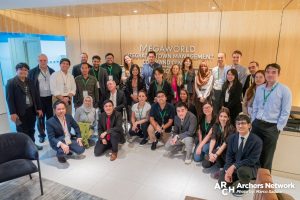
Together, the site visit illustrated the value of strong academe–industry linkages in aligning innovation needs with the design and delivery of micro-credentials for the AI era.
The Conference on AI Governance and Safety: Understanding the Impacts of AI and Enabling Partnerships in the Philippines
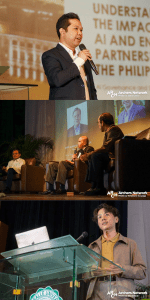 On the final day, participants attended the Conference on AI Governance and Safety, a side event organised by DLSU alongside the ASEFInnoLab6 Conference.
Opening remarks from Dr Raymond Girard TAN, Vice-President for Research and Innovation, DLSU, highlighted the importance of responsible AI development and application, particularly within higher education. This was followed by a presentation from Dr Robert Kerwin BILLONES, who introduced the Frontiers Champion: AI Governance and Safety initiative, tracing the evolution of AI governance research and showcasing emerging national partnerships in the Philippines.
Perspectives from government, industry, and academe—shared by representatives from the Department of Information and Communications Technology, Globe Telecom, and DLSU—reinforced the need for responsible design, privacy safeguards, and institutional accountability.
The afternoon featured policy-oriented reflections from Mr Kenneth LEUNG and Mr Aviral KAINTURA (NetMission.Asia APPO), culminating in the launch of the AI Governance and Safety Research Project.
The programme concluded with a Government-Industry-Academe Forum, reflecting on collective pathways towards ethical, future-ready AI frameworks in higher education.
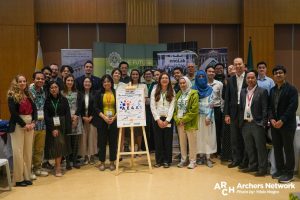
We welcome the cohort to the growing Asia-Europe for Artificial Intelligence AE4AI Network, and thank our host, volunteers, participants, and resource persons for all their dedication and contributions towards making this conference a success!