
How can higher education institutions shape the role of AI in ways that are inclusive, ethical, and grounded in human values?
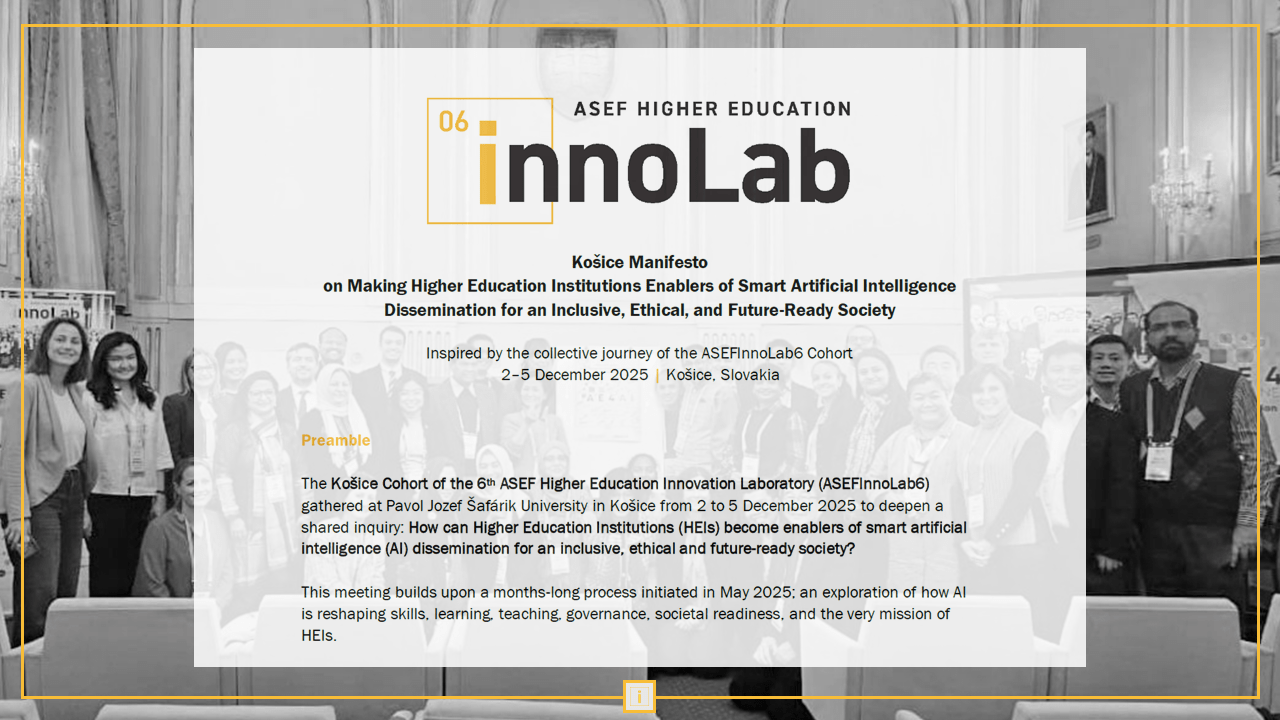
This question guided discussions during the 6th ASEF Higher Education Innovation Laboratory (ASEFInnoLab6) Conference in Košice held from 2-5 December 2025 at the Pavol Jozef Šafárik University in Košice, Slovakia. Bringing together more than 40 experts, academics, researchers, and higher education leaders from across Asia and Europe, the conference provided a space for participants to reflect on the evolving role of universities in an increasingly AI-driven world.
Building on several months of collaboration since May 2025, participants explored how HEIs can become enablers of smart AI dissemination for an inclusive, ethical, and future-ready society. These reflections culminated in the Košice Manifesto, which presents ten principles as a synthesis of the cohort’s insightful discussions.

Key Highlights of the Manifesto
The Košice Manifesto centres on the idea that AI should serve human development, not define it. As reflected in the discussions: AI is not the story itself. The real story is humanity’s capacity to harness it wisely.
With this, the manifesto calls for human-centred and ethical AI skills to form the foundation of AI readiness. Universities are encouraged to go beyond technical training, fostering critical thinking, responsibility, and inclusion, while ensuring that AI is used to augment human creativity, judgement, and learning.
At the same time, the manifesto highlights the need to safeguard human cognitive autonomy and strengthen the role of educators in guiding this transformation. HEIs are encouraged to invest in continuous professional development, peer-based learning, and reflective practice, while creating safe environments where experimentation and innovation are supported.
Finally, the manifesto envisions HEIs as AI-enabled ecosystems that connect academia, industry, policymakers, and communities. It calls for stronger governance frameworks that ensure transparency, accountability, and trust in AI systems, alongside efforts to expand AI literacy across disciplines and society. By widening access and engaging diverse stakeholders, universities can help ensure that the benefits of AI are shared more equitably and contribute to a more inclusive and future-ready society.
Why This Manifesto Matters
The Košice Manifesto reflects a broader shift in how the role of universities is understood in the context of AI.
Rather than being passive adopters of new technologies, HEIs are increasingly recognised as active shapers of how AI is developed, governed, and applied in society. This includes not only advancing technical knowledge, but also guiding ethical frameworks, informing policy discussions, and preparing learners for complex, rapidly changing environments.
Importantly, the manifesto also demonstrates the value of cross-regional collaboration. By bringing together diverse perspectives, opportunities for shared learning and mutual understanding are created. This ensures that approaches to AI are informed by a plurality of contexts and experiences.
■ ■ ■
We are especially grateful to all members of the Košice Cohort whose insights, openness, and collaborative spirit made this collective reflection possible. Our sincere appreciation also goes to our resource persons, partners, and most importantly our host, Pavol Jozef Šafárik University in Košice for hosting the conference. Dr Claudio RIVERA (RTU Riga Business School), our ASEFInnoLab6 Strategic Advisor, was also instrumental in conceptualising and facilitating the insightful discussions and the drafting of this call to action. Their combined contributions continue to shape an evolving dialogue on the role of higher education in fostering an inclusive, ethical, and human-centred AI future.
As the cohort reflects:
Let AI be the air, but let humans remain the breath.