
This webinar series has concluded.
For eligible participants who completed all four sessions,
we will be issuing your certificate by 15 July 2026.
Artificial intelligence is rapidly reshaping how societies learn, work, govern, innovate, and respond to global challenges. While AI has shown strong potential to support progress across social, economic, and environmental dimensions of sustainable development, it also raises urgent questions around equity, safety, accountability, access, bias, and the ethical frameworks needed to guide its use.
In this evolving landscape, universities have a particularly important role to play. As centres of learning, knowledge creation, innovation, and public responsibility, higher education institutions are well placed to help shape how AI is researched, governed, taught, and applied in service of society.
This June, the 7th ASEF Higher Education Innovation Laboratory (ASEFInnoLab7) held its Trailblazers Webinar Series, a series of knowledge-building sessions guided by this edition’s theme “The Role of Universities in Advancing AI for Good.” The series featured experts from the ASEFInnoLab community of practice, network of experts, and partner organisations, who shared insights, good practices, and emerging approaches from across Asia and Europe on how universities can leverage AI for the common good.
The webinars took place on Wednesdays in the month of June and was open to the public. Learn more about the sessions below and our incredible lineup of speakers:
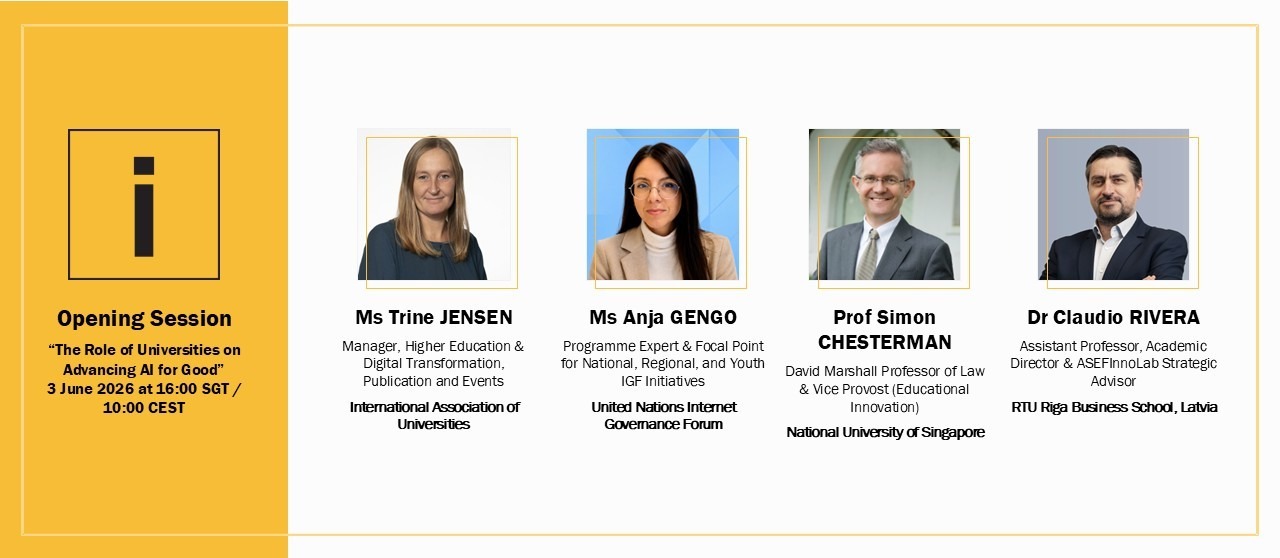
We opened the ASEFInnoLab7 Trailblazer Webinar Series with a timely panel discussion framing the role of universities in shaping AI in ways that are ethical, inclusive, and oriented toward the common good. Bringing together perspectives from higher education, policy, and global governance, it set the tone for the series by highlighting why universities matter in advancing AI for good.
Get to know our lineup of speakers:
We heard thought-provoking presentations on timely issues that universities need to navigate in this era permeated by AI:
Ms Trine JENSEN shared global survey insights showing that universities are actively navigating AI’s opportunities and risks, with a strong call to steer digital transformation by purpose, ethics, and institutional readiness. In her talk, Ms Anja GENGO framed AI governance as a borderless, multi-stakeholder challenge, emphasising universities’ unique role in capacity-building, interdisciplinary knowledge, and inclusive global participation. This was followed by a presentation from Prof Simon CHESTERMAN, which challenged universities to rethink their purpose in the age of AI, moving beyond information transmission toward judgement, creativity, integrity, and distinctive public-interest research.
This session has already concluded. Watch the recording here.
In this session, we examined two important dimensions of universities’ role in advancing AI for good: navigating the evolving global AI governance landscape and equipping learners with human-centred AI skills. By connecting regulatory trends with practical uses of prompt thinking and prompt engineering, the session explored how universities can foster more responsible, effective, and socially beneficial AI engagement.
We welcomed the following speakers from the ASEFInnoLab community:
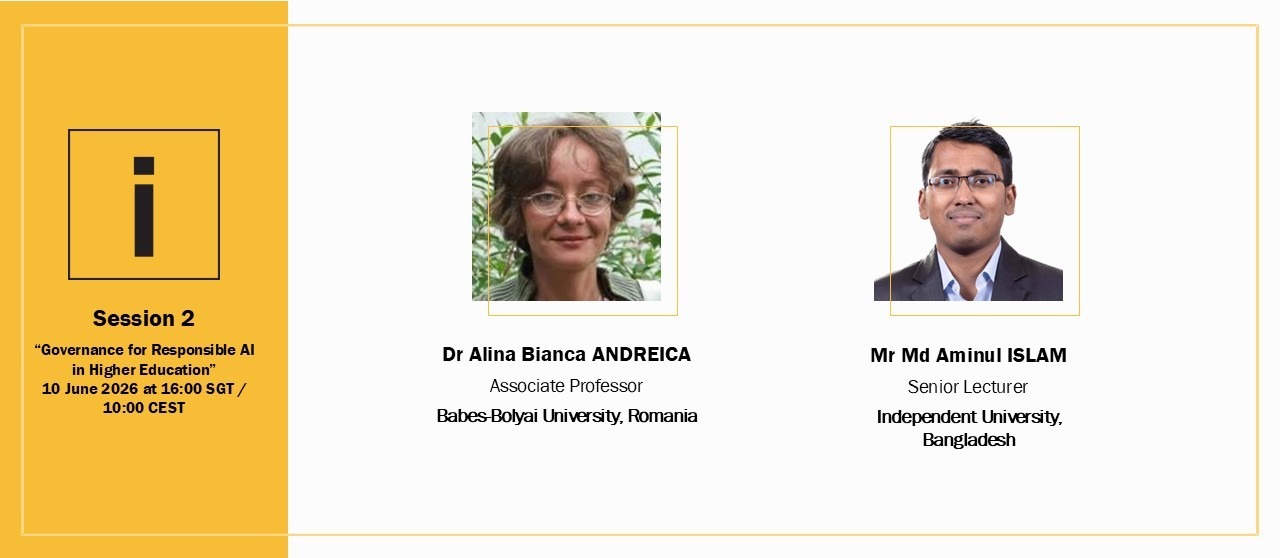
Dr Alina Bianca ANDREICA (Babes-Bolyai University, Romania) provided a global overview of AI regulations, highlighting the importance of human-centric governance, AI literacy, and the responsible use of AI tools in education. Mr Md. Aminul ISLAM (Independent University, Bangladesh) focused on “prompt thinking” as an essential skill for higher education—encouraging learners not only to ask how to use AI, but also why, when, and whether it should be used.
Together, the session underscored how universities can connect responsible AI governance with the skills learners need for an AI-powered future.
This session has already concluded. Watch the recording here.
This session showcased how micro-credentials help universities respond to emerging skills needs by offering flexible, targeted, and collaborative learning pathways. It featured outcomes from the 6th ASEF Higher Education Innovation Laboratory‘s Micro-credential Programmes (MP) Track, which highlighted a practical, holistic approach to designing micro-credentials.
Get to know our line-up of speakers below.
This session has concluded. Watch the recording here.
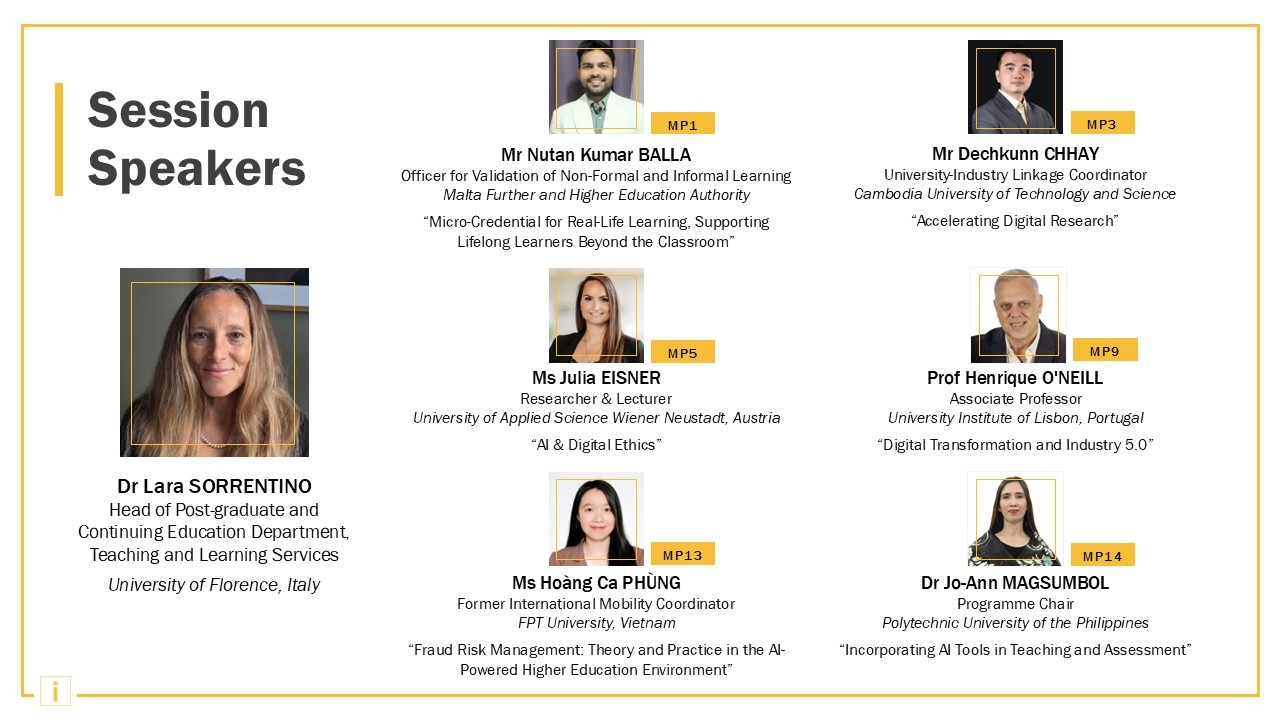
We opened the session with a presentation by Dr Lara SORRENTINO (University of Florency, Italy), which highlighted the value of micro-credentials in an era of rapid technological obsolescence, demographic change, and labour-market disruption which increase the need for flexible upskilling and reskilling. She introduced ASEFInnoLab6’s Micro-credential Programmes (MP) Track and shared a five-step methodology in developing micro-credentials.
We welcomed teams from ASEFInnoLab6’s MP Track, each represented by a colleague who shared the highlights of their concept/prototype, lessons learned, and steps forward as they prepare for possible implementation.
- MP01 Micro-Credential for Real-Life Learning, Supporting Lifelong Learners Beyond the Classroom. Presented by Mr Nutan Kumar BALLA (Malta Further and Higher Education Authority), this is is a five-week inclusive micro-credential that equips migrants, asylum seekers, non-digital natives, and vulnerable adult learners with practical AI skills for everyday life through an NGO-led train-the-trainers model.
- MP03 Accelerating Digital Research Methods in Higher Education: Ethical and Practical AI Integration. This micro-credential aims to equip learners with the digital, ethical, and methodological competencies required to conduct AI-integrated research in higher education. Key learning outcomes include identifying appropriate tools for specific stages of the research process and demonstrating digital literacy and ethical awareness. This was presented by Mr Dechkunn CHHAY (Cambodia University of Technology and Science) on behalf of his team.
- MP05 AI & Digital Ethics. Presented by Ms Julia EISNER (University of Applied Science Wiener Neustadt, Austria) this is a micro-credential for responsible innovation and trustworthy AI. Its modules will focus on AI governance and regulation, responsible AI engineering, and a case lab on trustworthy AI in practice.
- MP09 Digital Transformation and Industry 5.0. This is a non-degree course proposal shared by Prof Henrique O’NEILL (University Institute of Lisbon, Portugal) with three delivery pillars: it features a flexible blended format, delivered by expert faculty, and will be stackable. This programme’s target outcomes are enabling participants to analyse digital transformation contexts, evaluate AI implications, design sustainable strategies, and build digital roadmaps.
- MP13 Fraud Risk Management: Theory and Practice in the AI-Powered Higher Education Environment. Presented by Ms Hoàng Ca PHÙNG (FPT University, Vietnam), this programme seeks to provide targeted training aimed at higher education institutions and their faculty and staff, building their capacity to detect fraud and their confidence to use AI tools. For universities, the programme aims to contribute towards enhanced institutional resilience and trust and improve data security practices.
- MP14 Incorporating AI Tools in Teaching and Assessment. Presented by Dr Jo-Ann MAGSUMBOL (Polytechnic University of the Philippines), this programme aims to address gaps found by the team, such as AI literacy gap, uncertainty in adopting assessments, and the need for ethical, responsible AI use in this area. Now ready for its pilot phase, this programme features a stackable curriculum anchored on a hands-on, scenario-based learning approach.
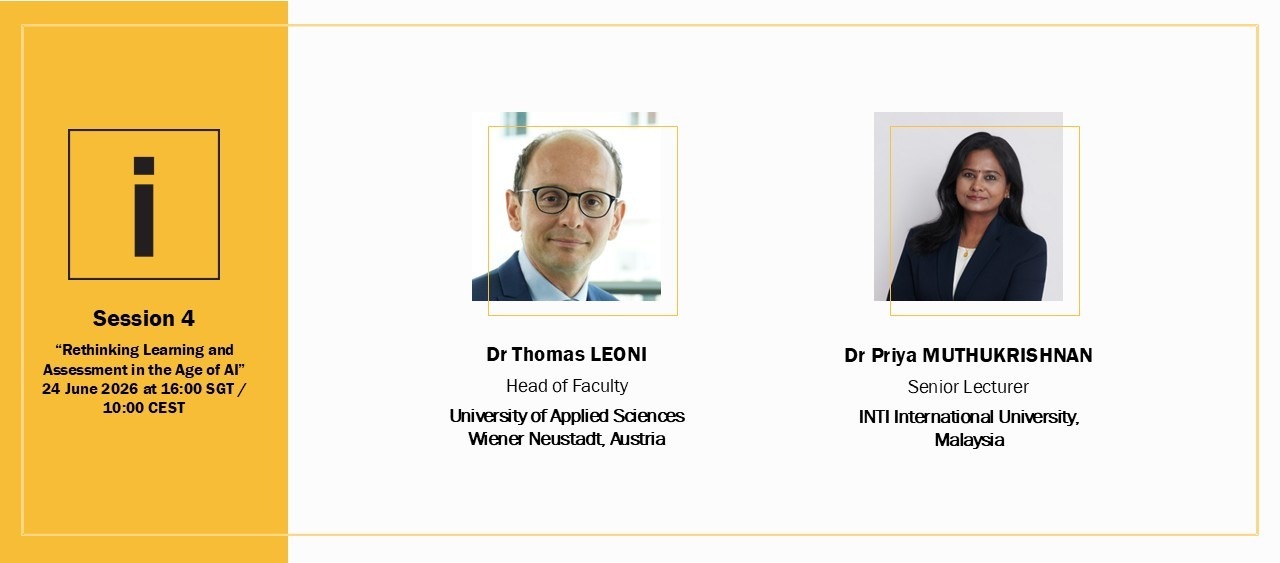
Our fourth session explored how universities can respond constructively to the rapid integration of AI in higher education. Bringing together perspectives on assessment reform, critical thinking, and learner agency, the webinar examined how AI is reshaping academic practices while reaffirming the importance of human judgment, reflection, and responsible use. Our speakers shared practical frameworks and institutional examples to highlight how universities can move beyond detection-based approaches and instead design learning environments that strengthen students’ ownership, competencies, and contribution to the common good.
We welcomed the following experts from the ASEFInnoLab community:
This session has concluded. Watch the recording here.
Dr Thomas LEONI (University of Applied Sciences Wiener Neustadt, Austria) shared how his faculty is rethinking thesis supervision and assessment in response to students’ growing use of generative AI. He introduced a redesigned approach that shifts beyond product-only assessment by combining the written thesis with process evidence, reflective milestones, oral defence, and revised criteria that promote transparency, competence development, and responsible AI use. This was followed by a presentation by Dr Priyadarshini MUTHUKRISHNAN (INTI International University, Malaysia) where she explored how AI can both support and weaken students’ growth mindset, critical thinking, and cognitive ownership. Her research work further encouraged educators to guide students toward wiser AI use that strengthens independent thinking rather than replacing it.
What were the benefits of the sessions for our participants?
The ASEFInnoLab7 Trailblazers Webinar Series offered a space for higher education stakeholders to hear more about how universities can respond to AI not only as a technological shift, but also as a societal challenge. Through the series, participants gained knowledge and ideas, insights, and good practices from institutions and experts across Asia and Europe.
For many colleagues working in areas such as governance, digital transformation, teaching and learning, sustainability, micro-credentials, or higher education policy, this series offered an opportunity to engage with current debates and connect with a broader community of practice.
When were the sessions held?
📅 Every Wednesday, June 2026
🕓 16:00-17:30 SGT / 10:00-11:30 CEST
💻 Online via Zoom
🌐 Open to the public
W thank all of our speakers and participants for joining us as we explored how universities can help advance AI for the common good. Our appreciation also goes to our partner organisations Fudan University, University of Nottingham, the International Research Centre for Artificial Intelligence, UN Internet Governance Forum, International Association of Universities, German Academic Exchange Service, ASEM Education Secretariat, and the Asia-Europe for AI Network for this edition of ASEFInnoLab. their strong support enabled us to organise a fruitful, timely series of sessions that reached hundreds of participants from Asia, Europe and beyond.