
As geopolitical tensions, supply-chain disruptions, and technological dependencies reshape the global economy, economic security has emerged as a defining concern for governments and business worldwide. Both Asia and Europe are now reassessing how to strengthen resilience while maintaining openness and economic cooperation, in an increasingly fragmented international landscape.
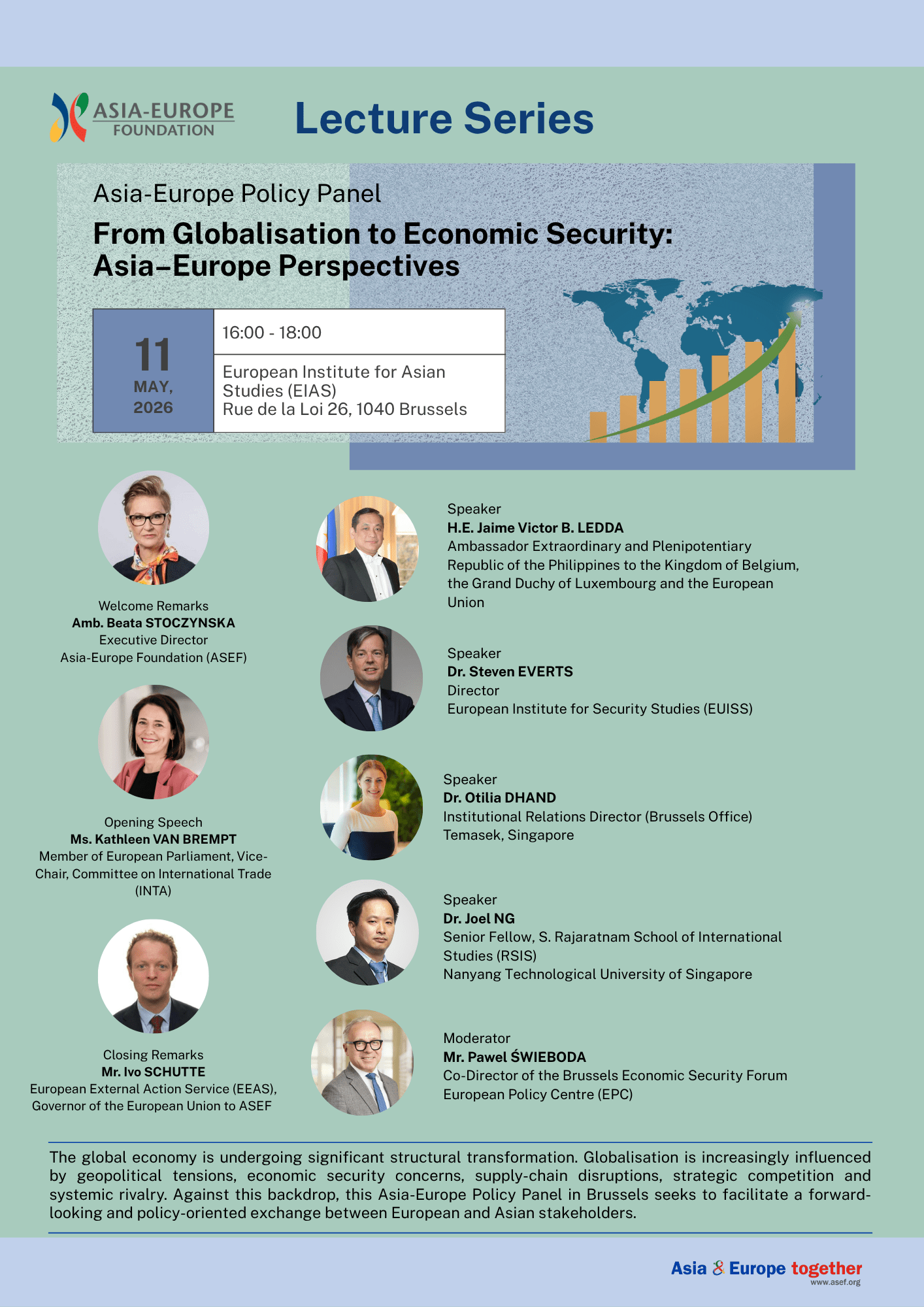
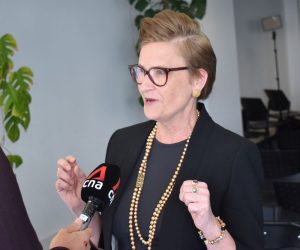
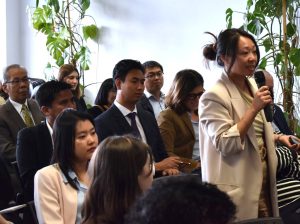
 In light of this, the Asia-Europe Foundation (ASEF), convened the Asia-Europe Policy Panel on 11 May 2026 in Brussels. Bringing together diverse stakeholders from government, academia and business from both regions, the event was a policy-oriented discussion on navigating economic security concerns while upholding an open and rules-based international order. The programme commenced with welcome remarks delivered by Executive Director of ASEF, Amb. Beata STOCZYNSKA, who highlighted the growing strategic importance of Asia-Europe dialogue amid evolving geopolitical challenges. These reflections were reinforced by Member of the European Parliament and Vice-Chair of the Committee on International Trade Kathleen VAN BREMPT, who underlined the strengthening relations between the European Union and Asian countries driven by the shared need to connect with like-minded middle powers, to protect democracy and international law.
Building Resilience in a Fragmented Global Economy
A central theme of the discussion was how unpredictability, rather than interdependence itself, has become the major challenge facing the global economy. Panellists reflected on how geopolitical tensions, the COVID-19 pandemic, the war in Ukraine, and cascading financial crises have exposed vulnerabilities in global supply chains and financial systems. Governments and business alike have been turning to economic security and risk management measures which could potentially contribute to long-term fragmentation. The speakers noted predictability as a key foundation for global stability, emphasising the importance of dialogue, trusted partnerships, harmonised regulatory frameworks in maintaining confidence in international trade and investment.
 The panel also explored how both ASEAN and the EU are recalibrating interdependencies without abandoning openness. While Europe is weighing vulnerabilities linked to overdependence on energy and critical raw material imports, ASEAN countries are similarly strengthening regional cooperation in sectors like food security, logistics and supply-chain management. The discussions highlighted that the ASEAN-EU relationship extends beyond a traditional buyer-seller dynamic; ASEAN was described as a growing centre of innovation, production and systemic reform, while the EU was recognised as a valuable partner for supporting governance, digital transformation and institutional development across ASEAN.
The Future of Asia-Europe Co-operation
On global governance, the panellists recognised that while multilateral institutions like the World Trade Organization are facing constraints, they continue to be platforms for engagement for like-minded actors. The discussion highlighted the need for multiple approaches like multilateral forums, issue-based coalitions and regional partnerships for sustainable global policy alignment and rule of law. The EU and ASEAN operating on similar principles with different tools and speeds was noted as a realistic approach to the new global order.
 Technology governance emerged as a major area for future cooperations, with panellists highlighting the risks of “invisible dependencies” in digital and financial infrastructure, including global payment systems. Opportunities for cooperation were also identified in AI governance, digital infrastructure for Micro, Small & Medium Enterprises (MSMEs), clean energy transition and food security. The panellists highlighted that these opportunities also raise broader questions on governance frameworks, resilience, sovereignty, innovation and systemic risk that need to be addressed. Overall, the panel emphasised that resilience would depend not only on reserves and stockpiles, but diversified supply chains, interoperable systems and sustained coordination across critical sectors. Furthermore, the private sector in both regions was identified as essential partner in navigating economic security and coordination.
The panel concluded with a reaffirmation of the commitment to deepening Asia-Europe engagement on economic security, resilience and rules-based cooperation. The closing remarks underscored the importance of structured dialogue and highlighted ASEF’s role as a bridge between European and Asian perspectives.
Key Policy Takeaways
- Resilience without isolation: Both regions favour a recalibration of interdependence rather than a rupture, ultimately building resilience without sacrificing the economic benefits of openness.
- Predictability is the key: In an unstable global order, businesses have abandoned cost-efficiency to strengthen economic resilience. Ensuring that the governance frameworks worldwide are stable and harmonised is the solution to foster global trade.
- Convergence on principles, divergence on instruments: ASEAN and the EU share overarching goals around rules-based trade and multilateralism, but differ on the tools and speed of adjustment, reflecting distinct geopolitical exposure and domestic political economies.
- Critical sectors as a priority for cooperation: Clean energy, food security, and digital connectivity were identified as areas where joint action could strengthen the relations between ASEAN and the EU.
- Institutional frameworks matter: While defective, international organisations are essential to build new partnerships and strengthen existing Asia–Europe mechanisms that can translate political dialogue into actionable cooperation.
- The role of the private sector: Businesses from both regions were identified as essential partners in navigating economic security, with calls for greater private coordination.