
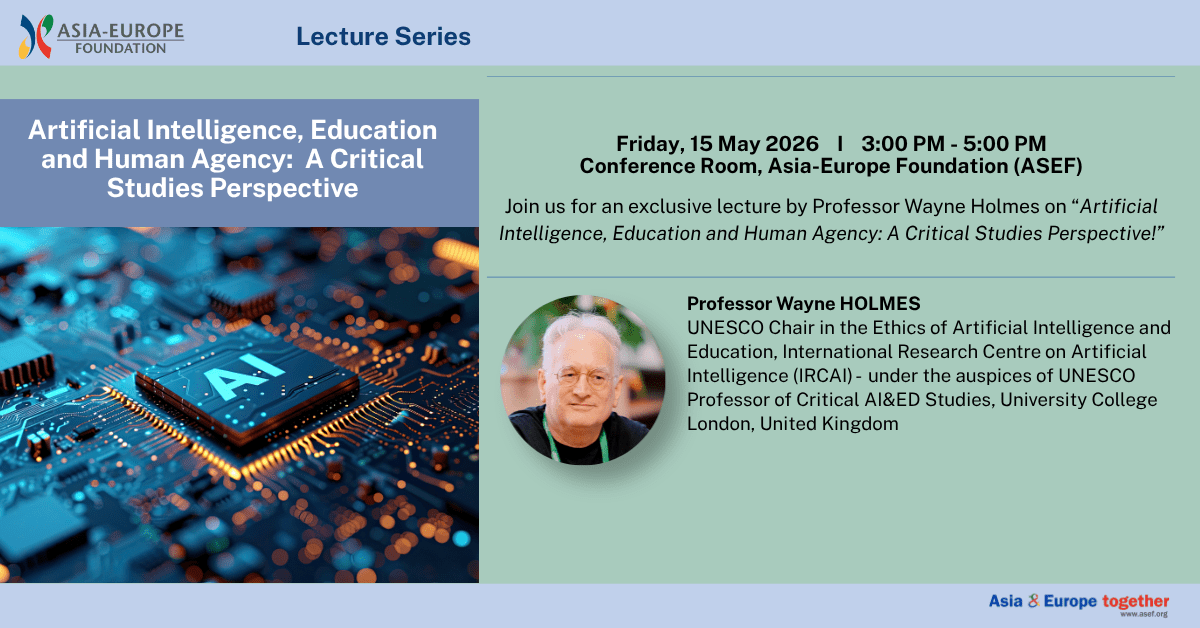
On Friday, 15 May 2026, the Asia-Europe Foundation (ASEF) hosted the latest edition of the ASEF Lecture Series in Singapore, featuring Professor Wayne Holmes, UNESCO Chair in the Ethics of Artificial Intelligence and Education at the International Research Centre on Artificial Intelligence (IRCAI) under the auspices of UNESCO, and Professor of Critical AI and Education (AI&ED) Studies at University College London.
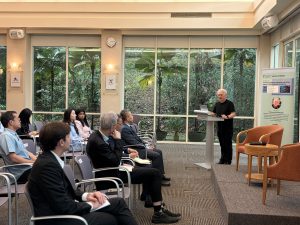 Titled “Artificial Intelligence, Education and Human Agency: A Critical Studies Perspective,” the lecture brought together educators, researchers, policymakers, students, and members of the public to critically examine the growing role of Artificial Intelligence (AI) in education systems worldwide.
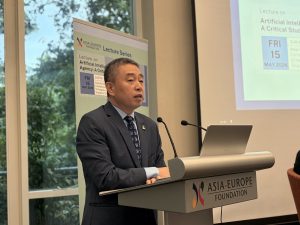
Opening the session, Mr ZHANG Lei, Deputy Executive Director of ASEF, highlighted the urgency of critically engaging with AI’s expanding role in education. He noted that governments, schools, and technology companies around the world are investing heavily in AI-driven educational solutions, often presenting AI as education’s “next great revolution.” However, he also emphasised that important questions are frequently overlooked amid the enthusiasm surrounding technological innovation.
“When AI enters the classroom, what happens to human judgment, teacher autonomy, and student agency?” Mr Zhang asked. “Who decides what ‘good learning’ looks like? What risks do we create for creativity, critical thinking, privacy, and equity?”
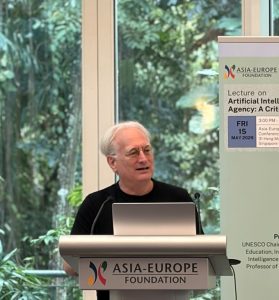
As AI technologies continue to rapidly impact societies and educational environments, the lecture provided an important platform to reflect critically on challenges presented by the integration of AI into teaching and learning. While AI is frequently promoted as a transformative solution to longstanding educational challenges, from personalised learning and automated assessment to improved efficiency and scalability, Professor Holmes urged participants to look beyond the dominant narratives surrounding AI and education.
Throughout the lecture, Professor Holmes challenged the assumption that AI alone can resolve education’s most complex and deeply human problems. Drawing from a critical studies perspective, he examined how many current approaches to AI in education risk oversimplifying issues related to pedagogy, ethics, surveillance, efficacy, and human agency.
Professor Holmes argued that discussions around AI in education often focus narrowly on technical skills and AI literacy understood merely as learning how to use AI tools. Instead, he advocated for a broader and more human-centred understanding of education, one that empowers individuals to think critically, exercise agency and engage ethically with AI.
The lecture also addressed pressing concerns surrounding surveillance, data privacy, bias, accountability, and equity in AI-enabled educational systems. Participants were invited to reflect on how AI technologies may reinforce existing inequalities or reshape power dynamics within classrooms and institutions if implemented without sufficient ethical consideration and democratic oversight.
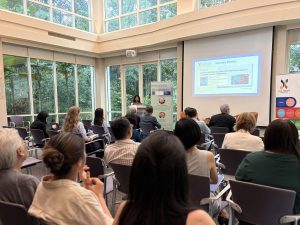 Moderated by Jyoti Rahaman, ASEF’s Project Lead for Education Innovation, the session concluded with a dynamic discussion between Prof Holmes and participants, underscoring the growing global interest in ensuring that technological innovation in education remains grounded in human values, social responsibility, and inclusive pedagogical practices.
In his closing remarks, Mr ZHANG Lei thanked Professor Holmes for his “deeply thought-provoking and timely lecture,” noting that the discussion reminded participants that conversations about AI in education are fundamentally about people, values, ethics, and the kind of future societies hope to build.
“Education should not merely prepare people to use AI tools,” he stated, “but empower them to thrive, flourish, and exercise meaningful agency in a world increasingly impacted by AI.”
ASEF extends its sincere appreciation to Professor Wayne Holmes for sharing his expertise and insights, and to all participants who contributed to this rich and timely conversation.
As AI continues to shape the future of education globally, ASEF remains committed to fostering critical dialogue, intercultural exchange, and collaborative learning between Asia and Europe on emerging issues at the intersection of education, technology, ethics, and society.
To learn more about ASEF’s recent project in education and innovation where Prof Holmes is contributing, visit:
• ASEF Classroom Network (ASEFClassNet)
• Asia-Europe Education Next Fellowship (ASEFNextEd)