
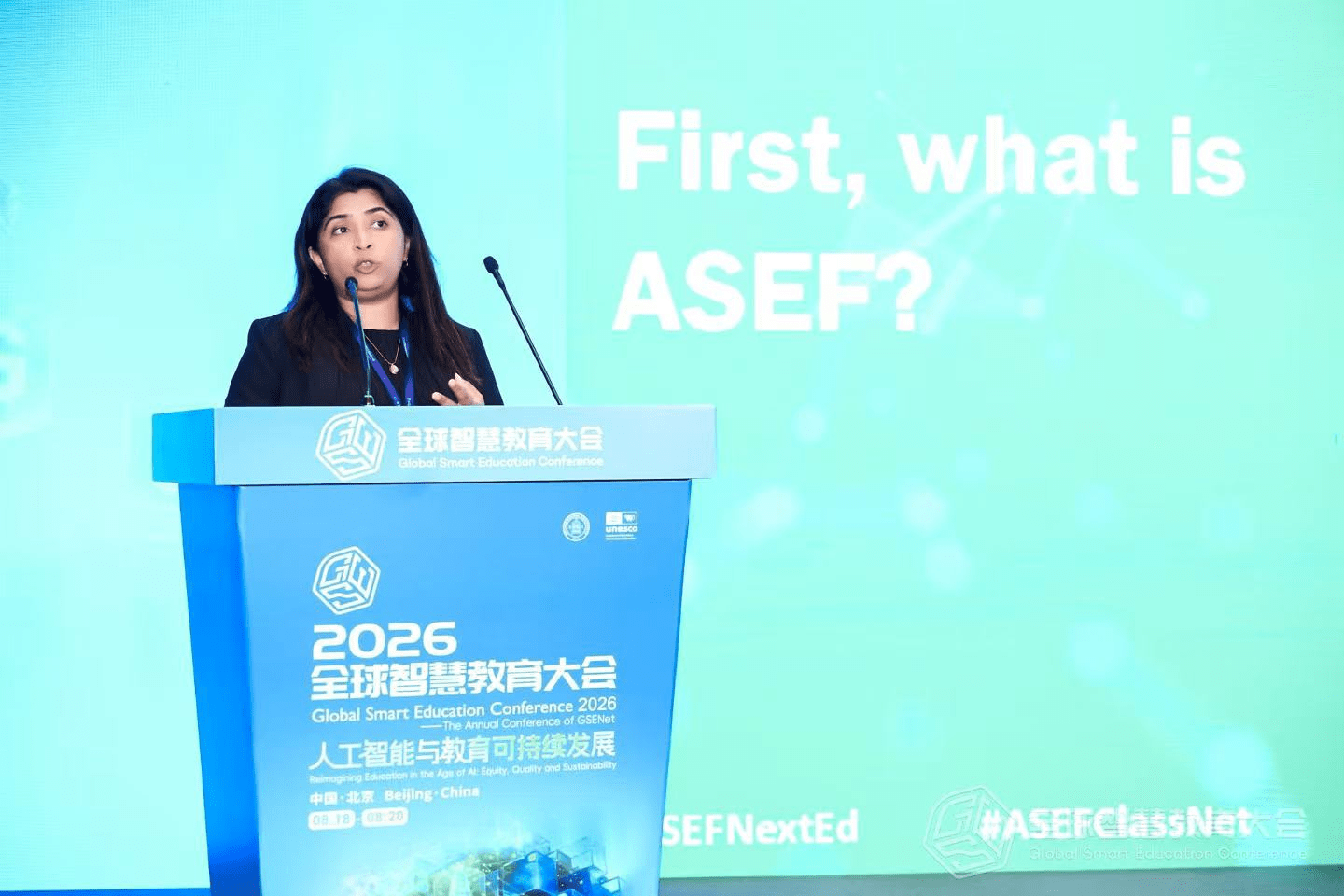
The Asia-Europe Foundation (ASEF) was once again invited to contribute to the Global Smart Education Conference (GSE2026), held in Beijing, China, from 18 to 20 August 2026. Co-organised by Beijing Normal University and the UNESCO Institute for Information Technologies in Education (UNESCO IITE), the conference brought together education leaders, researchers, policymakers, practitioners and technology experts from around the world to explore the opportunities and challenges emerging from the rapid integration of artificial intelligence (AI) into education.
Under the overarching focus on artificial intelligence and sustainable development in education, GSE2026 provided an important international platform for reflecting on how education systems can harness AI while preserving the human-centred purpose of education. The conference explored how technological innovation can contribute to more equitable, inclusive and high-quality education, while addressing emerging questions around ethics, educational quality and the future of learning.
Re-thinking Intelligence: What Should Schools Teach in the AI Era?
Representing ASEF, Ms Jyoti Rahaman, Project Lead – Education Innovation, Education Department, ASEF, spoke at the conference on “Re-thinking Intelligence: What Should Schools Teach in the AI Era?”
Building on ASEF’s engagement with the Global Smart Education Conference in 2025, where ASEF highlighted the importance of human agency and empowering teachers to lead pedagogically sound AI-driven innovation, this year’s keynote took the conversation further: beyond asking how schools can use AI, it asked a more fundamental question, what should schools teach when AI can increasingly perform tasks that were once considered uniquely human?
As generative AI and increasingly capable AI systems become part of everyday life, education faces a critical moment of reflection. Schools have traditionally placed considerable emphasis on acquiring knowledge, producing answers and developing cognitive skills that can now, in many cases, be augmented or performed by AI systems.
This raises an essential question for educators and policymakers: If AI can increasingly access, generate and process knowledge, what forms of intelligence should education seek to cultivate in young people?
In her presentation, Ms Rahaman explored the need to rethink intelligence not simply as the ability to know more or produce correct answers, but as the capacity to question, reason, create, collaborate, exercise judgement and act responsibly.
She argued that the rise of AI does not make knowledge, critical thinking or human capabilities less important. Rather, it requires schools to reconsider how these capabilities are developed, connected and applied in a world where humans increasingly work alongside intelligent machines.
From AI Literacy to Human Intelligence
The presentation highlighted the importance of moving beyond a narrow focus on AI literacy and technical skills. While students need to understand how AI systems work and how to use them effectively and responsibly, schools also need to create opportunities for learners to develop the human capabilities that enable them to navigate an AI-mediated world.
These include the ability to:
- ask meaningful and sophisticated questions;
- distinguish information from knowledge and evidence from assertion;
- reason, evaluate and exercise independent judgement;
- imagine possibilities and create new ideas;
- collaborate with both humans and AI systems;
- understand different perspectives and demonstrate empathy;
- make ethical decisions and take responsibility for their actions; and
- use knowledge and technology to address real-world challenges.
The presentation therefore invited educators to consider a fundamental shift: from asking what AI can do for education to asking what education should do for human beings in an age of AI.
Re-thinking What and How We Assess
The emergence of increasingly capable AI also challenges conventional approaches to teaching and assessment.
If AI can generate essays, solve problems, produce presentations and provide answers within seconds, schools need to reconsider what constitutes meaningful evidence of learning. Rather than simply assessing whether students can produce a particular output, educators may increasingly need to assess the processes behind learning, how students formulate questions, evaluate information, make decisions, collaborate, revise ideas and reflect on their own thinking.
This does not mean abandoning knowledge or academic rigour. Instead, it calls for a richer understanding of learning in which knowledge becomes the foundation for reasoning, creativity, judgement and action.
Such a shift has important implications not only for students, but also for teachers, curriculum designers, school leaders and education policymakers.
The Role of Teachers in an AI-Enabled Education System
The discussion also reinforced a central message from ASEF’s work through the ASEFClassNet programme: technology alone cannot transform education.
Teachers remain central to determining how AI is introduced into classrooms, how learning experiences are designed and how students develop the capabilities needed to thrive in an increasingly AI-enabled society.
ASEFClassNet’s emphasis on peer learning, Communities of Practice and teacher agency provides an important foundation for this transition. By creating opportunities for educators to exchange experiences, reflect on emerging practices and collaboratively develop innovative approaches, teachers can become active designers of AI-enabled learning rather than simply users of new technologies.
This is particularly important as education systems navigate rapidly changing technologies alongside questions of ethics, equity, inclusion and educational quality.
From Human Agency to Re-thinking Intelligence
ASEF’s participation in GSE2026 builds on its contribution to the global conversation on AI and education.
In 2025, ASEF highlighted “Leading with Human Agency: Empowering Teachers to Thrive in the AI Era”, emphasising the importance of empowering teachers to shape AI-driven innovation in teaching and learning.
In 2026, the conversation moved from who should lead AI-enabled education to a deeper question about what education should ultimately cultivate.
As AI capabilities continue to expand, the purpose of education may need to become clearer, not less relevant. The challenge is not to compete with machines on their strengths, but to ensure that education develops people who can think with AI without surrendering their thinking to AI; use technology without being defined by it; and make informed, ethical and human-centred decisions in an increasingly intelligent world.
For ASEF, this is central to building future-ready education systems across Asia and Europe, education systems that do not simply prepare learners to adapt to technological change but empower them to shape the future of technology and society themselves.
Through platforms such as ASEFClassNet, and ASEFNextEd, ASEF continues to connect educators across Asia and Europe, enabling them to exchange practices, develop professional competencies and collectively explore how education can respond to the opportunities and challenges of the AI era.
Learn more about the Fellowship that tackles the Future of Education here: ASEFNextEd1 Fellowship
Have questions about the Fellowship? Reach out to us at: nexted@asef.org