
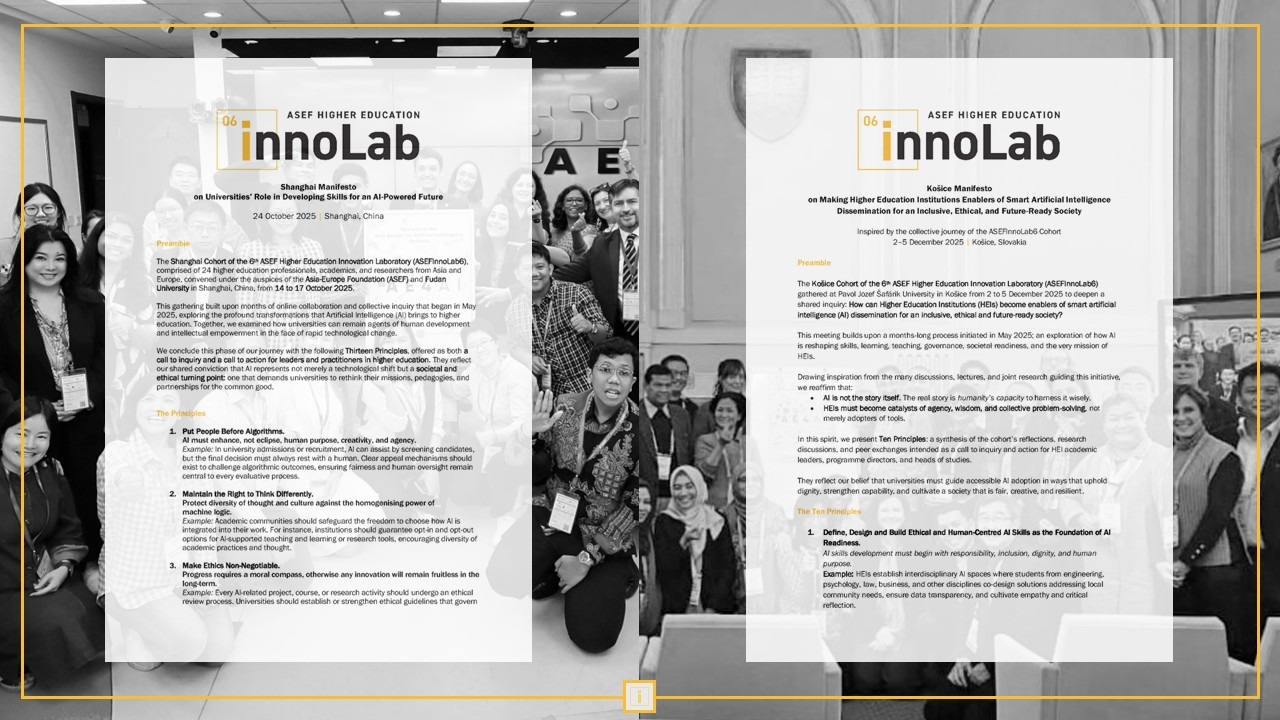
The 6th ASEF Higher Education Innovation Laboratory (ASEFInnoLab6) conference series brought together diverse voices from Asia and Europe to explore how universities can navigate the rapid evolution of artificial intelligence (AI). True to this, we are proud to share that our events in China and Slovakia gave their cohorts of experts, academics, and researchers the opportunity to co-develop complementary manifestos that reflect a shared commitment to shaping AI in ways that remain grounded in human values.
In an age of rapid AI advancement, what role should universities play in ensuring technology serves people and society?
The Shanghai Manifesto was developed during the conference held from 14-17 October 2025 at Fudan University in China. Co-created by 24 academics, researchers, and higher education professionals, it presents 13 principles that call on universities to rethink their role in an AI-powered future. At its core is a strong human-centred approach, urging institutions to ensure that technology enhances human agency, creativity, and critical thinking. The manifesto emphasises equity and access, advocating for lifelong and flexible learning pathways such as micro-credentials. It also encourages universities to act as “living laboratories” that foster interdisciplinary collaboration, innovation, and civic engagement, while embedding ethics and accountability into AI governance.

How can higher education institutions shape the role of AI in ways that are inclusive, ethical, and grounded in human values?
The Košice Manifesto was developed during the conference held from 2-5 December 2025 at Pavol Jozef Šafárik University in Košice, Slovakia. More than 30 participants contributed to shaping this second manifesto, which distils the cohort’s discussions into 10 principles focused on advancing a human-centred and ethical AI future. It highlights the need for universities to go beyond technical training and nurture critical thinking, responsibility, and inclusion. The manifesto calls for safeguarding human cognitive autonomy, strengthening the role of educators, and investing in continuous professional development. It also positions universities as connectors between academia, industry, policymakers, and communities, with a responsibility to build trust, transparency, and equitable access in AI systems.
Together, the two manifestos reflect an evolving understanding of higher education’s role in the age of AI. They position universities not only as adopters of technology, but as active shapers of how AI is developed, governed, and applied. By bringing together perspectives from across Asia and Europe, they demonstrate the value of collaboration in addressing shared challenges and building a more inclusive and future-ready society.