Topic Overview
 Through this edition bearing the theme “The Role of Universities in Advancing AI for Good”, ASEFInnoLab7 will explore how AI is researched, governed, and applied at universities in service of the common good.
The ASEFInnoLab7 will deliver two main components: a white paper lab and a public webinar series. This call is only for the white paper lab component. These outputs will articulate strategic pathways for higher education institutions, providing insights to higher education leaders and education policymaker. The white papers will focus on following areas:
- #AI4GlobalGood: Universities harnessing AI to contribute to global social, environmental, or economic sustainability and the Sustainable Development Goals (SDGs)
- #AI4PublicInterest: Universities strengthening public understanding, inclusion, trust, and engagement through policymakers, legislators and the broader public
- #AI4InstitutionalExcellence: Universities seeking proper AI governance, policies, and infrastructure for enhanced excellence of the institution and its contribution to public good
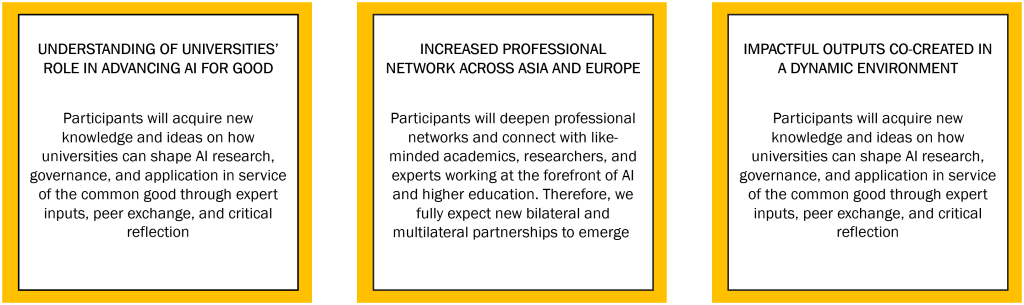
What will our participants get out of ASEFInnoLab7?
Knowledge, ideas, connections, and a project.
Programme Design
The ASEFInnoLab7 programme will offer both online and onsite components. For applicants of this Call for Interest, the journey will begin in May after a thorough selection process.
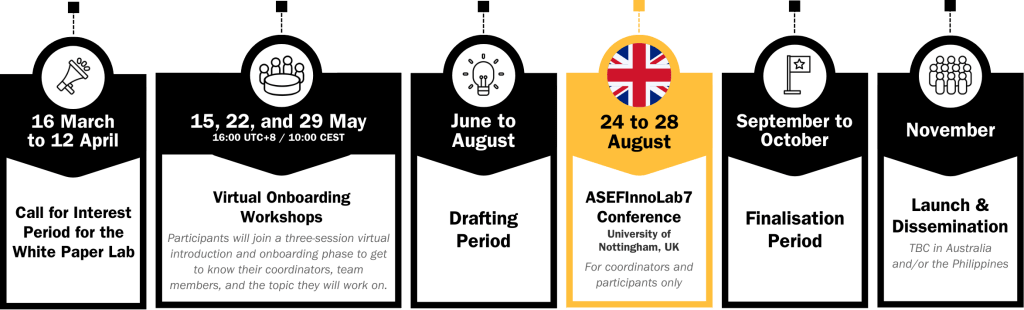
- Online Introductory Sessions: Selected participants will be onboarded through three introductory webinar sessions for the whole ASEFInnoLab7 cohort, which will take place on 15, 22, and 29 May. They will familiarise themselves with the principles of project aim, white paper development and teamwork.
- Self-organised Team Collaboration: Between June to August, participants will collaborate with their assigned team of 5-6 to develop the first draft of their white paper under the leadership of their team coordinator. These sessions will be self-organised and online. The teams will be finalising their initial white paper drafts in a similar fashion between September and November.
- Onsite Event: The teams will be invited to present their draft at the ASEFInnoLab7 Conference to be hosted by University of Nottingham in the United Kingdom in August 2026. As an experiential, collaborative programme, the conference will welcome around 60 participating experts and will have an array of interactive sessions that will facilitate peer-to-peer learning to aid the finalisation of the white papers.
ASEFInnolab6 provided me with key insights as to how many countries around the world are dealing with the AI onslaught in key areas of our lives such as education and work. While AI and IT infrastructures may provide ways and means to make things easier for each of us, we need to remember that the connectedness and connectivity we have as people are the things that a machine can never replicate.

Platforms like ASEFInnoLab are incredibly valuable because they bring together voices from very different contexts - Asia and Europe - to learn from one another and build shared solutions to common problems. When it comes to AI, no single country or institution has all the answers. ASEF creates spaces where we can learn from each other, compare experiences, and define shared goals for using AI responsibly and ensure AI benefits people everywhere. The real skill for the AI era lies in combining critical thinking and digital literacy with a strong sense of human values.

During ASEFInnoLab5, I had the opportunity to exchange knowledge on AI with incredible people from many different backgrounds and cultures. During the programme, I was enriched by my fellow participants' insights and had opportunities to provide my own perspectives. Now I will be able to further discuss many of the interesting ideas I've gathered at my university with the goal of implementing them.

One insight that really stayed with me from the ASEFInnoLab6 Conference was how creativity and innovation blossom when people from different cultures and backgrounds come together. Seeing so many passionate individuals share their ideas and work collaboratively was truly inspiring. It reminded me that welcoming diverse perspectives not only broadens our understanding but also sparks fresh and creative solutions. This experience has encouraged me to approach my own work with more openness to collaboration and teamwork, knowing that good projects often comes from collective effort.

Participating in the ASEFInnoLab5 online programme broadened my perspective on strategic planning and equipped me with practical tools and a newfound confidence in navigating uncertainty. By exploring multiple, diverse futures, [through the Scenario Planning method] we were able to identify potential risks and opportunities that might not have been apparent through traditional planning methods. Overall, the ASEFInnoLab5 online programme was an invaluable experience. I highly recommend this experience to anyone who is passionate about AI and emerging technologies and who is looking to enhance their strategic thinking.

ASEFInnolab5 inspired me to dive even deeper into the field of AI in education. Opening our eyes on issues that can emerge from this field's momentum gave us insight to a lot of challenges that aligns with our passion to create a more innovative educational system that focuses on value creation.

ASEF was great experience on a professional and personal development level. GREAT organization, like a design sprint with experts, peer feedback, learning, socializing, cultural exchange. The learning outcome and paper we have produced are exceptional for this time frame. The experts and support from ASEF along the way made this possible.

One of the most empowering moments of the ASEFInnoLab6 Conference was realising how naturally our teams created synergy - between individuals in each team and also between teams. The differences didn't divide us, they simply added more layers of perspective. What really mattered was the professionalism, the curiosity, and the drive each person brought to the table. That mix created a feeling of building something genuinely new, while also feeling unmistakably part of a community. It's rare to experience that kind of belonging in an international setting, and it's something I'm taking forward.

I liked the opportunity of working together with a diverse group of people from various backgrounds, nationalities and experiences. I had heard of strategic foresight before, but had never gone through the actual process. Doing just this with excellent instructors and mentors was unforgettable.

Currently, in the field of arts, there is great debate on the ethics of using AI in our practice, and even more so in teaching as a tool in the current curricula. As one half of art education is skill building itself, having the machine do your work for you brings in the contention of where the learning is taking place. Through the sessions in ASEFInnoLab5, followed by the debates with one's fellows from alternate fields, it allowed one to see the potential of how it can be incorporated in arts education as well, and hopefully I'll be taking some things learnt from here to share, discuss, and implement with our colleagues in our own department.