
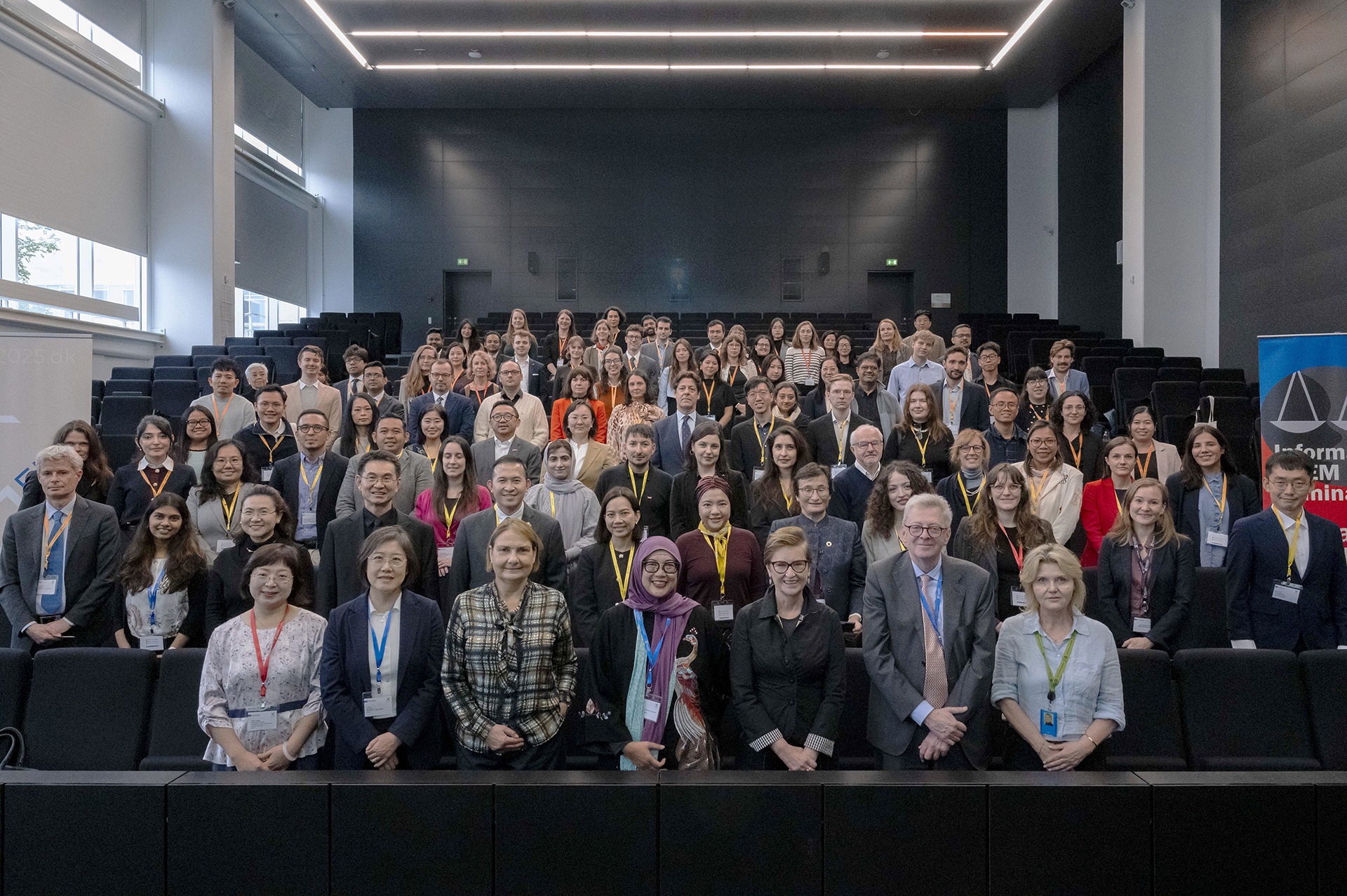
Artificial Intelligence (AI) is a double-edged sword in the context of human rights. Given the rapid advancement of the technology and its pervasiveness on human lives, a discussion on the AI’s implications on human rights proved extremely timely at the 23rd Asia-Europe Meeting Human Rights Seminar (ASEMHRS) held in Copenhagen Denmark from 29-31 October 2025. The Seminar, hosted by the Danish Ministry of Foreign Affairs in partnership with the University of Copenhagen, brought together over 100 experts and practitioners working at the intersection of human rights and AI to collectively examine, share, and deliberate on the topic. To ensure a holistic and comprehensive discussion, the participants represented key stakeholder sectors, namely academia, business, civil society organizations (CSO), and governments from Asia and Europe.
The event was inaugurated by Lone MOUYAL, the Vice-Dean for Research from University of Copenhagen’s Faculty of Law, and Ambassador Beata STOCZYŃSKA, the Executive Director of Asia-Europe Foundation (ASEF). In her speech, Vice Dean MOUYAL highlighted AI’s antithetical roles as a challenger and facilitator of human rights and cautioned against AI innovation’s repercussions on human dignity, equality, and justice.
The following keynote discussion underscored the importance of steering AI development toward a more human-centric and inclusive approach that strikes a balance between innovation and regulation. Expert human rights practitioners like Louise HOLCK, Executive Director for the Danish Institute for Human Rights and Kajsa OLLONGREN, EU Special Representative (EUSR) for Human Rights shared their perspectives. Executive Director Holck stated that AI should not only be efficient but also serve justice, and EU Special Representative Ollongren countered the notion that regulation stifles innovation by suggesting that “smart” innovation builds trust and forms the foundation of progress. The discussion also reviewed progress made through regional and global frameworks, such as the EU AI Act, while reaching a strong consensus on the need for greater efforts to turn principles into practice.
The keynote panel also included two of the background paper authors, Dr. Virginia DIGNUM and Dr. TANG Yingxia whose remarks prefaced their presentation of the Seminar background paper. Dr. Dignum aptly summarized the essence of the session by stating the need to enable technology that serves humanity. Later, Dr. Rachele CARLI, Postdoctoral Researcher at the Responsible AI Group, Umeå University joined the two experts to summarise the background paper, introduce the working group topics, and emphasise the important gaps and improvement areas for AI governance and human rights protection in Asia and Europe.
The first day ended with an interactive panel discussion on AI in public service that juxtaposed the delivery of services against the violation of human rights. It highlighted and suggested recommendations towards fundamental lacunae such as governments’ inability to understand algorithmic operationalities, lack of AI integration across the different levels of governments, and insufficient AI literacy in society.
The second day was dedicated to in-depth discussions on the three working group topics, namely Privacy and Data Protection, Equality and Non-Discrimination, and Remedies and Access to Justice. Simultaneous detailed deliberations were conducted in each working group by assigned working group role-players, Dr. Anja Møller PEDERSEN and Smita MITRA; Dr. Sue Anne TEO and Dr. Virginia DIGNUM; and Caleen OBIAS and Nele ROEKENS. The three rapporteurs, Smita Mitra, Dr Virginia Dignum and Nele Roekens, shared brief snapshots and recommendations of the working group sessions with all the participants on the final day.
All working groups explored the nuanced implications of AI on a specific human right. Among other things, the privacy group discussed the lag of legislation behind technological advances and proposed recognising full data ownership as a human right. Meanwhile, the non-discrimination group emphasised improving data quality, distinguishing “data sets” from “data swamps,” and tackling algorithmic proxy bias. The access to justice group examined accountability gaps, transparency issues, and power asymmetries hindering redress. It called for stronger enforcement of existing human rights instruments and the establishment of independent, well-resourced oversight bodies to ensure accountability and protection against AI-related harms.
The final day concluded with a session titled “Shaping the Future of AI: A Human Rights View from Asia and Europe.” The discussion emphasised the need to strengthen the implementation of existing human rights frameworks across both regions. One panellist proposed establishing dedicated human rights courts in Asia, highlighting regional accountability gaps. The conversation also revisited pressing concerns such as AI hallucinations, the urgency of safety regulations, and the importance of promoting AI literacy. In closing, participants reflected on the seminar’s four key recommendations and how they, in their individual and organizational capacity, could advance these commitments to ensure the protection and promotion of human rights in the age of AI.
→ View the Seminar programme here.
→ View photos from the Seminar here.
→ View Seminar Key Outcomes and Recommendations here

ABOUT THE ORGANISERS
The Informal Asia-Europe Meeting (ASEM) Seminar on Human Rights series was launched in 1997 to strengthen relations between civil society actors and governments in Asia and Europe on human rights issues. The Seminar series is co-organised by the Asia-Europe Foundation (ASEF), the Raoul Wallenberg Institute (nominated by the Swedish Ministry of Foreign Affairs), the Philippine Department of Foreign Affairs, the Swiss Federal Department of Foreign Affairs, and the Ministry of Foreign Affairs of the People’s Republic of China, with support of the European Union and the Ministry of Foreign Affairs of Denmark.
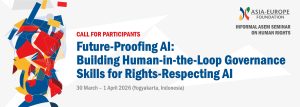
Capacity-Building Programme on Rights-Respecting AI Governance (30 March- 1 April, Yogyakarta, Indonesia). For more details, go here.